The “Gravity-Grip” Kerfuffle: A Case Study in Friction (and Frictionless Logistics)

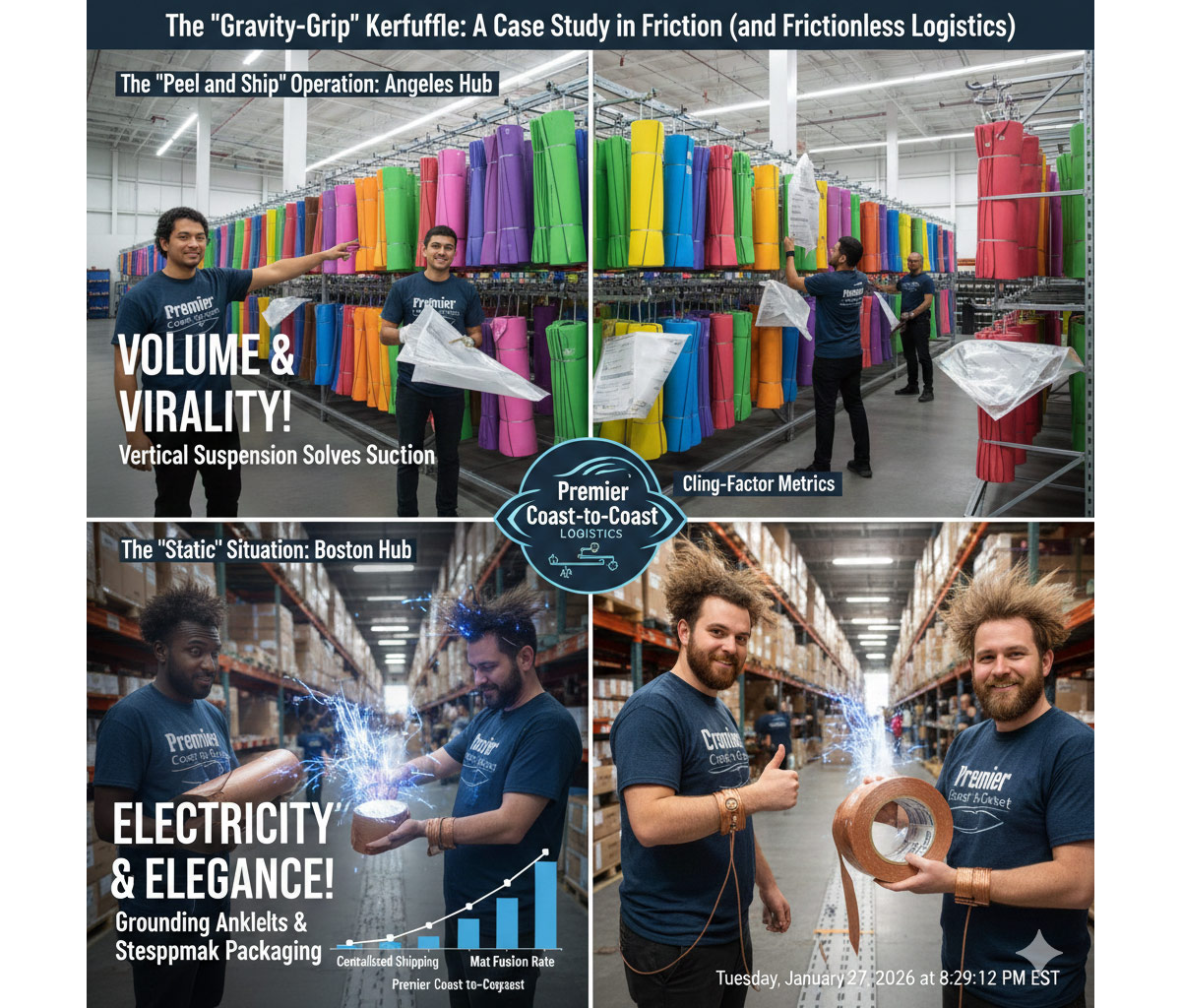
Images of the yoga mat being sold at the warehouse.

As the Marketing Director of Premier Coast-to-Coast Logistics, I’ve spent a lot of time explaining that fulfillment isn’t just “moving boxes.” It’s an art form. It’s a dance. Sometimes, it’s a high-stakes wrestling match with physics.

While most of our clients ship normal things—like shoes that stay in their boxes or books that don’t try to escape—we recently took on a project for a startup that tested the absolute limits of our Los Angeles and Boston facilities.

Enter the Gravity-Grip Infinite Yoga Mat.

The Product: A Material Science “Oopsie”

The folks at Sub-Zero Gravity Labs (fictional, obviously) invented a proprietary material called Static-Foam. The pitch was simple: A yoga mat that uses molecular suction to ensure your hands and feet never slip, regardless of how much you sweat.

The reality? The mat was too good. It didn’t just grip your hands; it gripped everything. If you laid it on a hardwood floor, you needed a crowbar to get it up. If two mats touched each other without a protective barrier, they became one single, inseparable Mega-Mat.

It didn’t need climate control. It didn’t need refrigeration. It just needed to be kept away from literally every other surface in the known universe.

The Strategy: The “Non-Stick” Bi-Coastal Split

The client was based in Sedona but had two massive, clashing demographics: the “Eco-Influencers” of Santa Monica and the “Industrial Loft Minimalists” of Boston’s Seaport District.

Shipping these from a single warehouse in the middle of the country was impossible. Why? Because the vibration of a long-haul truck caused the mats to “settle,” effectively fusing the entire pallet into a 500-pound block of rubber. We had to use our dual-hub system to minimize transit time and maximize “Anti-Cling” protocols.

  1. The Los Angeles Hub: The “Peel and Ship” Operation

In our L.A. facility, the challenge was volume. The West Coast launch went viral on a popular video-sharing app because a famous influencer got her leggings stuck to the mat and had to be cut out of them. Suddenly, everyone wanted one.

  • The Problem: We received 10,000 units of individual mats that were protected only by a thin layer of “De-Ionized Paper.” If that paper ripped, the mat would bond to the warehouse racking.
  • The Solution: Our L.A. team implemented the Vertical Suspension Method. Instead of stacking them, we used specialized hooks to hang the mats like cured meats in a deli.

The Result: We reduced “surface-bond incidents” to zero and maintained a lightning-fast pick-and-pack rate. Because our L.A. warehouse is only miles from the port, we were able to fulfill the “Influencer Wave” in under 24 hours.

  1. The Boston Hub: The “Static” Situation

While L.A. was dealing with volume, Boston was dealing with electricity. The air in a New England warehouse in late autumn is dry. Dry air + Static-Foam = A literal lightning factory.

  • The Problem: Every time a picker grabbed a Gravity-Grip mat, they generated enough static electricity to jump-start a dead car battery. Our team was getting zapped so hard their hair was standing up for three days straight.
  • The Solution: Sully, our Boston floor manager, didn’t panic. He outfitted the entire fulfillment team with Grounding Anklets. We also swapped our standard plastic packing tape for a specialized copper-infused linen tape that neutralized the charge upon contact.

The Result: Not only did we stop the accidental electrocution of our staff, but the copper tape became a “premium packaging feature” that Boston customers loved. It looked “steampunk,” apparently. We fulfilled 8,000 units across the Tri-State area without a single singed eyebrow.

The Fictional Data: Friction vs. Flow

To illustrate how our bi-coastal approach saved this launch, let’s look at the “Cling-Factor” metrics.

MetricCentralized Shipping (Hypothetical)Premier Coast to Coast (Actual)
Transit Time5-7 Days1-2 Days
Mat Fusion Rate12% (Pallets became blocks)0.01% (One mat stuck to a stapler)
Shipping Cost$22.00 per unit (Heavy/Oversized)$9.50 per unit (Local Zone delivery)
Worker Morale"I'm stuck to the floor""I love these grounding anklets"

Why Your Boring Product Deserves This Treatment

You might be shipping coffee beans, phone cases, or artisanal spatulas. Your products probably don’t generate 50,000 volts of electricity or fuse to the walls.

But the logistics principles remain the same:

  1. Zone Skipping Saves Margins: By stocking in L.A. and Boston, you aren’t paying the “Cross-Country Tax.” You’re paying local rates.
  2. Specialized Handling: Every product has a quirk. We don’t just “box it.” We understand it. If your product shouldn’t be stacked, we don’t stack it. If it shouldn’t be shaken, we cradle it.
  3. Scalability: When a product goes viral (for better or worse), you need two engines running, not one. If a blizzard hits Boston, your L.A. hub keeps the revenue flowing.

The Aftermath

The Gravity-Grip Infinite Yoga Mat is now a cult classic. Sub-Zero Gravity Labs is currently developing a “Frictionless Frying Pan” that is so slippery it’s actually illegal in three states.

Our L.A. and Boston teams are already preparing. We’ve ordered a shipment of high-friction gloves and a lot of industrial-strength nets.

Scaling Your Brand Shouldn’t Feel Like a Logistics Nightmare

You’ve done the hard part: you’ve built a brand people love. But as orders pour in, the “behind-the-scenes” can quickly become a bottleneck. If you’re spending more time taping boxes than chasing your next big idea, it’s time to level up.

Why Medallion Fulfillment & Logistics?

  • Bi-Coastal Efficiency: Slash shipping zones and delivery times with strategic warehouse locations that put your product closer to your customers.

  • Seamless Tech Integration: Whether you’re on Shopify, Amazon, or Magento, our system plugs directly into your store for real-time inventory and order tracking.

  • The “Unboxing” Experts: We specialize in custom kitting and high-touch packaging. We don’t just ship products; we deliver your brand’s personality.

  • Scalability on Demand: Whether you’re shipping 100 orders or 100,000, our infrastructure grows with you—no extra overhead required.

Ready to get back to what you do best? Let us handle the heavy lifting. Experience the precision, speed, and personal touch that have made Medallion a leader in eCommerce logistics.


Contact us today for a free price quote!

Tips for eCommerce Store Black Friday Promotions that Boost Sales

Tips to Grow Ecommerce Sales

Will you be giving thanks for a successful and profitable Black Friday in 2025? Our fulfillment warehouse staff shares easy and useful tips that will help create momentum to carry your eCommerce store through the holiday selling season.

1. Promote deeply discounted Black Friday deals.

Sales of 10 percent or 20 percent off are common enough during the rest of the year, but they won’t grab the attention of holiday shoppers. Strategically choose items to run for 40 to 50 percent off, or even buy-one-get-one free. Leverage bundling of these items to boost the average order value.

2. Segment your marketing campaigns.

Target these specific categories of shoppers, as identified by marketing automation platform Klaviyo:

• Deal-hunters

• Last-minute shoppers

• VIPs

• “Looky-loos”

• Impulse buyers

In addition, come up with a special “sweetener” to entice people who haven’t bought or who came close to purchasing.

3. Prepare the infrastructure.

Everyone’s heard horror stories of eCommerce sites crashing because they can’t handle the surge in business. Install an uptime monitor program that will alert you to possible problems and minimize downtown. Don’t forget to check the loading time, which can be another factor causing a high bounce rate.

4. Optimize for mobile-first buying.

Since 2022, mobile users accounted for nearly three-quarters of Black Friday sales for Shopify merchants. If you’re not already optimized for mobile shopping, there’s no more time to wait.

5. Streamline the checkout process.

Few things will kill an eCommerce sale faster than a cumbersome checkout procedure, especially with impulse shoppers. Features such as one-click buying, and dynamic checkout buttons remove the barriers to closing the sale.

Your #1 Fulfillment Warehouse for Year-Round Success

Whether it’s seasonal fluctuations or general business growth, Medallion Fulfillment & Logistics can handle all the changing needs of your eCommerce business. Contact us today to learn more.

Amazon is Drawing Increased Attention as Antitrust Chatter Grows

In the world of online retailing, Amazon is the proverbial 800-pound gorilla. The one-time bookseller has become a global juggernaut, allowing consumers to shop for everything under the sun from the comfort of their own home.

With annual revenue approaching $400 billion, it may seem as though it’s Amazon’s world and we’re just living in it. Earlier this year, a group of independent-business organizations joined forces to take aim at monopolies, with Amazon at the dead center of their target.

Small Businesses Feel the Squeeze

Over the years, Congress has enacted various antitrust laws designed to maintain a level playing field. The purported goal of such legislation is to prevent monopolies and promote a competitive marketplace.

In reality, these laws are only as strong as their enforcement. Larger companies have the means to play Goliath to the smaller companies’ David. In 2020, Amazon alone spent approximately $18 million to lobby against stricter antitrust measures.

It may seem as though fighting the retail giants would be a tall enough order. Adding insult to injury, many small businesses feel that industry organizations such as National Retail Federation (NRF) pay lip service to the idea of equal representation while quietly favoring their largest members.

Standing Up for Market Equality

In a proactive effort to regain some equitable conditions, more than 20 trade and business groups formed a coalition under the name, “Small Business Rising.” Members include organizations such as the National Grocers Association (NGA), the American Booksellers Association (ABA) and Institute for Local Self-Reliance (ILSR), a vocal critic of Amazon’s dominance.

Small Business Rising announced their formation and goals in an April 2021 press release. Amazon was specifically cited by name several times, making it clear what the organization sees as one of their biggest obstacles. As Stacy Mitchell, ILSR co-director stated, “concentrated market power” is the toughest challenge facing today’s small business owner.

The organization’s objectives call on policymakers to do the following:

*Break up tech monopolies, such as Amazon, to prevent them from cornering the online market.

* Add teeth to antitrust laws by making them stronger and more enforceable.

* Put a stop to mega-mergers and set higher criteria for regular mergers.

In addition, Small Business Rising is leveraging the relationships local business owners have with power players in their respective hometowns. Members are organizing meetings, seeking out media coverage and waging letter-writing campaigns.

The Rich Get Richer

The unprecedented conditions of 2020 served to magnify the gap between Amazon and other e-commerce businesses. While COVID restrictions created a surge in online shopping, small online retailers faced corresponding supply chain and distribution difficulties, making it hard for them to accommodate demand.

On the other hand, Amazon was able to draw on its significant resources to weather the storm and emerge stronger than ever. The company spent a reported $4 billion on “incremental COVID-19-related costs,” enabling it to successfully adjust its processes and policies.

In the face of mounting criticism during the last few years, Amazon has tried to brand itself as a valuable ally to small businesses, especially with Amazon Marketplace, its third-party online sales platform. Companies have responded by pointing out how Amazon uses prohibitive fees and data access for competitive advantage.

Grow Your Online Business with Medallion Fulfillment & Logistics

Are Amazon’s arbitrary and restrictive fees and policies helping or hurting your e-commerce business? Medallion Fulfillment & Logistics works with you by offering a full assortment of services tailored to fit your needs.

Contact us to learn more about our flexible and cost-effective fulfillment solutions, including our innovative Amazon replenishment warehousing service.

4 More Signs it’s Time to Outsource Fulfillment

Questions on Amazon

There are many reasons your business may consider outsourcing to a fulfillment service. The most important, although difficult to monetize, is time. Once your business has grown beyond the startup phase and begun to sustain itself, prioritizing your time, and that of your employees or partners, is crucial to continued success.

In addition to needing time to concentrate on business growth, here are four more signs that it is time to outsource your fulfillment.

Too Many Questions

You are an expert in your field. Your business knows its target markets and has a plan in place to increase sales. As your product offering widens and your customer base grows, your orders become less homogeneous. Soon you intend to pursue wholesale customers, increasing the variety even further. All of these changes bring questions.

What is the best shipping method for wholesale orders? Is it the same as retail orders? Should we use the same carrier for all packages to increase volume discounts, or can we save money in other ways? Do we need to stock more shipping box sizes? And, above all, are we paying too much for shipping?

A reliable fulfillment service already has the answers to your questions and will allow you time to market your business and develop your assets.

The Sea of Rising Costs

Shipping costs have risen over 60% in less than a decade. Many companies spend 10-12% of their revenue on shipping costs alone. Utilizing different carriers for different shipping scenarios can save money, but diffuses your volume discounts for a single business.

An established fulfillment service is able to offer discounted freight rates based on the volume they handle for all clients together. Leveraging this power in numbers will save your business more money than it can earn from its own volume discounts for many years, if not indefinitely.

As sales grow, many related costs increase: the staffing costs to pack and ship orders, packaging materials, storage space, shipping costs, returns processing, and more. This is in addition to advertising and marketing costs, manufacturing, freight, web development, legal and other expenses. And time, the most precious and nonrenewable resource. When the fulfillment need begins to drain resources, outsourcing is the decisive action that consolidates and manages these costs into one bill, one concern, one (very important) cog in the wheel.

A Barrier to Growth

Expanding to new markets and marketplaces requires planning and logistics management. The software integrations alone can save valuable time for a growing business. Third-party logistics partners (3PLs) like Sprocket Express have existing software integrations that can take your orders directly from most any shopping cart or marketplace and automatically process the orders through their system.

With expansion, peak season traffic also increases. This is great news for your business, but is your in-house capability ready for the heightened activity? With a professional fulfillment partner, your business can focus on promotions and social media, rather than shipping orders during busy times. They will have seasonal staff on hand to meet the demand and they have regular pickup, plenty of packing materials, and the experience to keep the whole thing running smoothly.

Trying to forge ahead once your business reaches the tipping point can impede your success. It’s like trying to start two businesses- one in your field and one in the fulfillment field. If that idea resonated with you, it is probably time to outsource.

Warehouse Space

Depending on your product line, warehouse space may become a concern early in the game. For businesses that import containers of goods, storage space is key. If your products are small and/or purchased in small quantities, it may not be urgent to find a separate location for storage. For those that deal with large items or quantities, a professional warehouse is immensely helpful. Over time, it will save money to use a warehouse rather than your own business space to house inventory.

Conclusion

Recreating a knowledgeable and experienced shipping department is a deviation of resources, both time and money. Once you have taken hold in your market, diverting your focus to this task may not be the best course of action. Outsourcing fulfillment at this crucial moment can streamline your operations and provide room to scale.

If you are ready to consider outsourcing your order fulfillment, contact us for more information.

Sprocket Express is a division of Medallion Enterprises and owned by Medallion Fulfillment & Logistics.

How to Take Product Photos for Your Store Like a Pro But on the Cheap

As online shopping continues to grow market share, the sense of touch has been removed from the buying process, making visual appeal more important than ever. According to ecommerce consultant BigCommerce, two-thirds of consumers rate image quality as “very important” when it comes to online purchases.

Before you rush out and hire a pricey photographer, check out these great tips for cost-effective and professional-looking DIY photos.

1. Technique Is More Important than Equipment

Don’t let anyone talk you into dropping hundreds or thousands of dollars on a state-of-the-art camera. If you can afford it, then by all means, but modestly priced cameras and even smart phones are capable of producing high-quality photos. Decisions such as lighting, staging and processing play a more significant role.

2. Create Your “Studio”

• Set up a table as close to a window as possible without getting into the shadow cast by the windowsill.

• Use poster board or mats to create a generic white background, “sweeping” it from the horizontal tabletop to the vertical wall to provide a seamless look.

• You’ll need at least two lights. Clamp-style is preferable as they stay in place but can be easily moved around. Make sure to use identical light bulbs with a cooler shade.

3. Include Action Shots When Appropriate

In many cases the white background will be sufficient, but some products have more appeal when shown in use. For instance, a picture of a person wearing sunglasses can be more attractive to potential customers.

4. Don’t Stop at One

Take a number of pictures of your product from a variety of sides and angles. Multiple views are the best way to overcome the two-dimensional aspect of online images.

5. Keep It RAW

For best results you should shoot in RAW format, which captures all of the visual data and gives you greater latitude in editing. In addition, changes don’t affect the original file so you won’t have to worry about losing data.

6. Evaluate and Adjust

After every session, review your work with a critical eye to see what worked and what didn’t, and then apply your findings to future photo shoots.

Ecommerce Fulfillment Services for the Busy Entrepreneur

Are inventory, order processing and logistics taking valuable time away from the business of driving sales? Contact Medallion Fulfillment & Logistics to learn more about our comprehensive ecommerce fulfillment services.