
Cracking the Retail Code: How to Handle B2B and Big-Box Distribution Without Penalties

Quick answer: To handle big-box distribution without penalties, businesses must strictly follow specific retailer routing guides detailing EDI integration, pallet sizing, and delivery windows.

Partnering with an experienced fulfillment warehouse like Medallion Fulfillment & Logistics ensures compliance, eliminates costly chargebacks, and seamlessly integrates B2B shipments with direct-to-consumer e-commerce orders.

Landing a contract with a major retailer or big-box store feels like a massive victory for any growing brand. Securing shelf space in stores like Target, Walmart, or Amazon provides massive brand exposure and significant sales growth. You have successfully created a product that consumers want, and now the retail giants want to stock it.

However, the celebration usually pauses the moment the logistics paperwork arrives. Fulfilling orders for major retailers introduces an entirely new layer of complexity compared to standard e-commerce shipping. Big-box stores enforce strict rules on exactly how products must arrive at their distribution centers. If your company fails to follow these rules, the retailer issues financial penalties known as chargebacks, which quickly consume your profit margins and damage your vendor scorecard.

You need a clear strategy to manage these complex logistical requirements. This guide explains how to navigate routing guide compliance, avoid expensive penalties, and set your business up for sustainable wholesale success. Understanding these core concepts is essential for growth:

  • The complexity of “routing guides” when selling to Target, Walmart, or Amazon.
  • Why a single labeling mistake can lead to massive chargebacks and lost revenue.
  • The difference between high-volume B2B shipping and individual B2C e-commerce orders.
  • How Medallion’s experienced team ensures 100% compliance with major retail rules.
  • Expanding your brand from online-only to a true omni-channel powerhouse.

What makes retail routing guides so difficult to follow?

Retailers use routing guides to mandate exactly how suppliers must prepare and deliver shipments. These manuals can be hundreds of pages long, outlining precise requirements for carton labels, pallet configurations, Bill of Lading (BOL) formatting, and electronic communication.

Target, Walmart, and Amazon process millions of items daily. They rely on highly automated distribution centers to move this inventory efficiently. If your pallet arrives with the wrong dimensions or a missing barcode, their automated systems cannot process it. The retailer must then step in manually. To recoup their labor costs, they pass those expenses back to you in the form of a chargeback.

Choose an in-house logistics model if your company possesses a dedicated compliance department to read and enforce these manuals. Choose an experienced fulfillment warehouse if you want to avoid the overhead of a compliance team while maintaining perfect vendor scorecards.

Why do specific pallet sizing and delivery windows matter?

Every retailer has specific pallet sizing requirements to fit their particular racking systems. If you send a pallet that is two inches too tall, the receiving dock will likely reject the shipment entirely.

Furthermore, retailers enforce strict delivery windows. Your shipment must arrive on a highly specific date. Arriving a day early causes dock congestion, while arriving a day late causes out-of-stock issues on the retail floor. Both scenarios result in severe financial penalties.

How does EDI integration affect compliance?

Electronic Data Interchange (EDI) is the standard method for exchanging business documents between companies. Big-box retailers require EDI integration to receive purchase orders, send advance shipping notices (ASNs), and process invoices. Manual data entry is rarely allowed. Failing to transmit an ASN before the truck arrives at the retailer’s dock is a direct violation of the routing guide, leading to automatic chargebacks.

Why do single labeling mistakes lead to lost revenue?

The difference between high-volume B2B shipping and individual B2C e-commerce orders lies in the financial stakes of a single error. In a direct-to-consumer (B2C) model, printing a shipping label slightly crooked rarely matters as long as the carrier can scan it.

In business-to-business (B2B) shipping, a single labeling mistake can lead to massive chargebacks. Retail routing guides dictate the exact placement of GS1-128 barcodes on the outside of every carton. If a label is placed on the top of the box instead of the side, or if the barcode is wrinkled, the retailer’s automated conveyor belts cannot read it. A minor penalty per incorrectly labeled carton across a high-volume shipment can instantly wipe out thousands of dollars of your revenue.

How can an experienced fulfillment warehouse prevent retail chargebacks?

Managing these strict requirements requires dedicated expertise. Medallion Fulfillment & Logistics has spent decades mastering these complex compliance laws so our clients do not have to. As a family-owned business, we understand the hard work you have invested in growing your brand.

Our team actively manages routing guide updates across major retailers. When a major retailer changes their label placement rules, our warehouse management system updates immediately to reflect the new standard. Medallion’s experienced team ensures 100% compliance with major retail rules by implementing multi-step quality control audits on every outbound B2B shipment. We build the pallets to exact specifications, apply labels precisely, and schedule freight carriers to meet tight delivery windows.

How does seamless integration support an omni-channel strategy?

Expanding your brand from online-only to a true omni-channel powerhouse requires unified inventory management. You cannot afford to segregate your stock into separate warehouses for wholesale and direct-to-consumer orders. Splitting inventory ties up your capital and leads to stockouts in one channel while the other sits on excess product.

Medallion Fulfillment & Logistics bridges the gap between these different sales channels. We provide seamless integration so you can fulfill Shopify orders and Amazon FBA/B2B shipments from the exact same inventory pool. Our technology connects directly with your shopping carts and wholesale EDI systems. When a customer buys a single item on your website, our team picks and packs it immediately. When Target orders ten pallets of that same item, we route the inventory accordingly.

This unified approach gives you complete visibility over your stock levels, empowering you to make accurate purchasing decisions and maximize your sales potential across every platform.

Are you ready to take your brand to the big leagues?

Scaling into wholesale distribution is a monumental step for your business. The potential for revenue growth is tremendous, provided you can navigate the logistical hurdles smoothly.

Don’t let strict retail guidelines hold your brand back from the big leagues. Let Medallion handle the compliance paperwork while you celebrate the sales. Our dedicated team is ready to streamline your operations, protect your profit margins, and help your brand thrive in the retail market.

[Get a Free B2B Fulfillment Quote Now]

Frequently Asked Questions about B2B Fulfillment

What are retail routing guides?

Retail routing guides are comprehensive instruction manuals provided by major retailers to their suppliers. They dictate the exact rules for packaging, labeling, palletizing, and shipping products to the retailer’s distribution centers to ensure efficient processing.

How do chargebacks impact business profitability?

Chargebacks are financial penalties issued by retailers when suppliers violate routing guide rules. These fees are deducted directly from the supplier’s invoice, which significantly reduces the overall profit margin of the wholesale order.

Can Medallion Fulfillment & Logistics handle both B2B and B2C orders?

Yes. Medallion Fulfillment & Logistics manages both direct-to-consumer e-commerce fulfillment and complex wholesale B2B distribution from a single inventory pool, allowing businesses to efficiently operate across multiple sales channels.

What is the difference between B2B and B2C fulfillment?

B2C fulfillment involves shipping individual items directly to consumers quickly and accurately. B2B fulfillment requires shipping large volumes of products on pallets to retailers, which demands strict adherence to complex routing guides and scheduled delivery windows.

Why is EDI integration necessary for big-box retail?

EDI (Electronic Data Interchange) allows the secure, automated transfer of essential business documents like purchase orders and shipping notices. Major retailers require EDI integration to eliminate manual data entry errors and streamline the receiving process at their highly automated facilities.

Contact us today to get a custom price quote for services.

Resilience in the Storm: Building a “Disaster-Proof” Supply Chain

Supply chain volatility is no longer a rare event. From sudden port labor disputes to severe weather anomalies, disruptions have become a regular part of doing business. When containers sit anchored offshore and freight costs unexpectedly spike, small to medium business owners are often the ones who feel the strongest financial impact.

Shipping delays directly erode customer trust and cut into your bottom line. Customers who expect fast, reliable delivery will quickly abandon their shopping carts if they see extended shipping times. Relying on a single distribution point leaves your business entirely exposed to regional bottlenecks, forcing you to constantly react to emergencies rather than focusing on growth.

Fortunately, you can protect your operations by building redundancy into your logistics network. By distributing your inventory strategically and leveraging established carrier partnerships, you can transform supply chain vulnerabilities into competitive advantages. Here is how adopting a multi-node fulfillment strategy keeps your business thriving, even when unexpected storms hit.

The single-point-of-failure risk

Placing all your inventory in one geographic location might seem easier to manage initially, but it creates a massive vulnerability. If a port strike or natural disaster shuts down your only warehouse region, your entire fulfillment operation grinds to a halt.

Consider the recent labor disputes that rattled the logistics industry. In October 2024, a major dockworker strike temporarily shut down 36 ports along the East and Gulf Coasts. Over 45,000 workers walked off the job, freezing roughly 40% of total United States cargo volume. Industry experts estimated the economic impact of that brief shutdown reached up to $5 billion per day. Even a short disruption creates massive operational backlogs. Supply chain analysts noted that just one week of a port strike can result in nearly a month of congestion and delays.

The West Coast has faced its own share of hurdles. Throughout early 2023, unresolved labor contract negotiations caused severe uncertainty at major ports like Los Angeles and Long Beach. Shippers became wary of potential lockouts and rapidly diverted their freight elsewhere.

When your business relies on a single warehouse, you have no safety valve during these crises. Your products sit stranded in containers, backorders pile up, and your customer service team is left apologizing for delays entirely out of your control.

Strategic redundancy: Splitting inventory from coast to coast

The most effective way to eliminate the single-point-of-failure risk is by decentralizing your inventory. A multi-node distribution strategy involves placing your products in multiple fulfillment centers across different regions. At Medallion Fulfillment & Logistics, our dual-coast footprint features strategic warehouse locations in Los Angeles and Boston.

Splitting your inventory between the West Coast and the East Coast provides a critical safety net. If an Atlantic storm delays shipments into Boston, your Los Angeles facility can seamlessly pick up the slack to keep orders moving. This geographic diversification ensures your business remains operational regardless of localized disruptions.

Beyond disaster mitigation, a dual-coast strategy offers several everyday business benefits:

  • Faster delivery times: Storing products closer to your end consumers drastically reduces transit times. You can consistently meet consumer expectations for fast shipping without relying on expensive expedited air freight.
  • Lower shipping costs: Shipping packages across the country eats into your profit margins. By fulfilling orders from the warehouse closest to the buyer, you reduce the shipping distance and lower your carrier costs.
  • Smarter inventory management: You can allocate your stock based on regional buying trends. If a particular product sells better on the East Coast, you can heavily stock the Boston facility to meet that specific demand.

The veteran’s advantage: Navigating tight capacity

Having a solid warehouse network is only half the battle. You also need reliable transportation to move your goods from the port to the warehouse, and from the warehouse to your customer. During times of severe supply chain disruption, carrier capacity tightens rapidly. Trucking shortages emerge, prices surge, and newer businesses often struggle to secure space on delivery trucks.

This is where experience becomes your greatest asset. Medallion Fulfillment & Logistics brings over 30 years of established relationships with major freight carriers and parcel networks. The logistics industry operates heavily on trust, volume, and long-term partnerships. Because we have spent decades collaborating with top-tier carriers, we secure priority space and better pricing for our clients, even during peak seasons or industry crunches.

You do not have to waste your valuable time negotiating spot rates or frantically searching for available trucks. Our veteran team leverages these deep-rooted connections to keep your shipping costs manageable while providing superior, uninterrupted service to your buyers.

Real-time agility with a unified tech stack

Managing inventory across multiple warehouses might sound complicated, but modern logistics technology makes it seamless. Effective multi-node distribution requires total visibility over your stock levels and incoming orders. You need to know exactly what products are sitting in Los Angeles and what is available in Boston at any given moment.

We utilize a unified tech stack that integrates warehouse management and order management directly with your eCommerce platforms. This technology functions as a central command center for your entire operation.

  • Automated order routing: When a customer places an order, the system instantly calculates the optimal fulfillment location. It factors in product availability, customer proximity, and current shipping rates to ensure the most cost-effective delivery.
  • Real-time inventory visibility: You can monitor your stock levels across both facilities from a single dashboard. This prevents stockouts and helps you accurately forecast when it is time to reorder from your suppliers.
  • Instant pivoting during disruptions: If a regional disruption occurs, you can immediately reroute fulfillment rules. The software allows you to pause shipping from an affected facility and automatically push all incoming orders to the operational warehouse.

This level of real-time agility turns sudden supply chain surprises into smoothly managed planned moves. Your customers simply receive their orders on time, completely unaware of the complex logistics executing behind the scenes.

Future-proof your fulfillment strategy

Selling your products and growing your brand is what you know and love. Constantly worrying about port congestion, weather delays, and carrier capacity takes your focus away from scaling your business. Building a resilient, disaster-proof supply chain requires strategic planning, trusted carrier relationships, and the right geographic footprint.

You can turn complex logistics into a seamless growth engine by partnering with an experienced third-party logistics provider. Keep your eCommerce shop running smoothly around the clock, no matter what disruptions occur globally. Contact us at Medallion Fulfillment & Logistics to learn more about our dual-coast capabilities and how we can customize an innovative, cost-effective solution to fit your specific business needs.

From Garage to Grand Scale: How eCommerce Fulfillment Services Drives Growth

Online shopping / e-commerce and customer satisfaction concept : The picture depicting consumers / buyers buy or purchase products and service at home via internet

We know exactly what it looks like. The dining room table is covered in packing tape, the garage is overflowing with inventory, and you are spending more time printing labels than you are designing new products. 

We know because we have been there. 

Medallion Fulfillment & Logistics is an American success story that started right in the Kent family garage years ago. We remember the late nights, the logistical puzzles, and the drive to build something meaningful. Today, we have grown into a national enterprise with warehouses on both the East and West Coasts, but we never forgot where we came from. 

That shared history allows us to understand your journey in a way that massive, impersonal logistics corporations simply can’t. We know that for growing brands, eCommerce fulfillment isn’t just about moving boxes—it’s about keeping promises to your customers while maintaining your sanity. 

The Scaling Wall: When DIY Stops Working 

Every successful online retailer hits a “breaking point.” It’s a good problem to have—it means your marketing is working and people love your product. But operationally, it can feel like a disaster. 

When you are shipping ten orders a week, handling it yourself is cost-effective. When you are shipping hundreds, the manual labor starts eating into the time you should be spending on strategy, marketing, and product development. 

This is the “Scaling Wall.” 

Recent data shows that consumer expectations are higher than ever. According to 2024 studies, roughly 63% of U.S. consumers expect two-day delivery. If you are fulfilling orders from a single location—or worse, your garage—meeting that two-day window without destroying your profit margins on overnight shipping costs is nearly impossible. 

If you stay behind the wall too long, your customer service suffers. Errors creep in. Shipping times lag. You need a partner to help you climb over that wall, and that is where professional eCommerce fulfillment services come into play. 

Beyond the Box: Technology and Integration 

A common misconception among business owners is that a fulfillment partner is just a rented warehouse with a few staff members. In reality, modern fulfillment is a technology business. 

To scale effectively, your inventory management needs to be synchronized with your sales channels in real-time. You cannot risk selling a unit on Amazon that you just sold on your Shopify store five minutes ago. 

At Medallion, our difference is in our innovation. We offer software solutions that fully integrate with the most popular third-party shopping carts. This means: 

  • Automatic Order Flow: Orders move from your site to our warehouse floor without you lifting a finger. 
  • Real-Time Visibility: You know exactly what is in stock, what is low, and what is shipping. 
  • Accuracy: Integrated systems drastically reduce human error. 

Research indicates that nearly half of consumers will stop buying from a brand after a poor delivery experience. By leveraging our integrated technology, you protect your brand’s reputation by ensuring the right product gets to the right person, on time, every time. 

The Bi-Coastal Edge: Speed Meets Affordability 

One of the biggest challenges in eCommerce fulfillment services is the geography of the United States. It is a massive country. 

If your inventory is sitting in a single warehouse in New Jersey, shipping a package to a customer in California forces that package to travel through high-numbered shipping zones (typically Zone 8). This results in two painful outcomes: 

  1. High Costs: Carriers charge significantly more for cross-country shipping. 
  1. Slow Delivery: Ground shipping coast-to-coast can take 5+ business days. 

This is where Medallion’s bi-coastal footprint becomes your secret weapon. 

We operate warehouses in Los Angeles and Boston. By splitting your inventory between these two strategic hubs, you can reach the vast majority of the U.S. population in 1-3 days via affordable ground shipping. 

This strategy, often used by the biggest players in retail, allows you to drastically reduce your “shipping zones.” A customer in San Diego gets their package from our LA warehouse. A customer in New York gets theirs from Boston. 

The result? You lower your average shipping cost per order while simultaneously increasing delivery speed. It turns your logistics from a cost center into a competitive advantage. 

The Family Business Difference 

In an industry increasingly dominated by venture-backed tech startups and massive conglomerates, the human element often gets lost. You become a ticket number in a queue, waiting 48 hours for a bot to reply to an urgent question about a lost shipment. 

That isn’t how we operate.

Medallion is still a family business. We believe in exceptional customer service and responsiveness because we know that when something goes wrong with an order, it’s your reputation on the line. 

When you partner with us, you are talking to real experts who care about your business continuity. We offer specialized services like Amazon Stock Warehouse Replenishment and startup programs because we understand the nuances of different business models. Whether you need specialized clothing fulfillment or complex kitting, we handle it with the care of a partner, not just a vendor. 

Join the Family and Start Scaling 

You didn’t start your business to become a professional box packer. You started it to create, to sell, and to grow. 

If you are ready to move from the garage to a grand scale, you need a fulfillment strategy that grows with you. We have the technology to integrate your sales channels, the bi-coastal presence to lower your costs, and the family-business values to treat your brand like our own. 

Don’t let logistics hold your growth hostage. 

Ready to streamline your shipping? Complete our free quote form today to speak with a eCommerce fulfillment services expert. Let’s build a solution that fits your needs now and in the future. 

The “Gravity-Grip” Kerfuffle: A Case Study in Friction (and Frictionless Logistics)

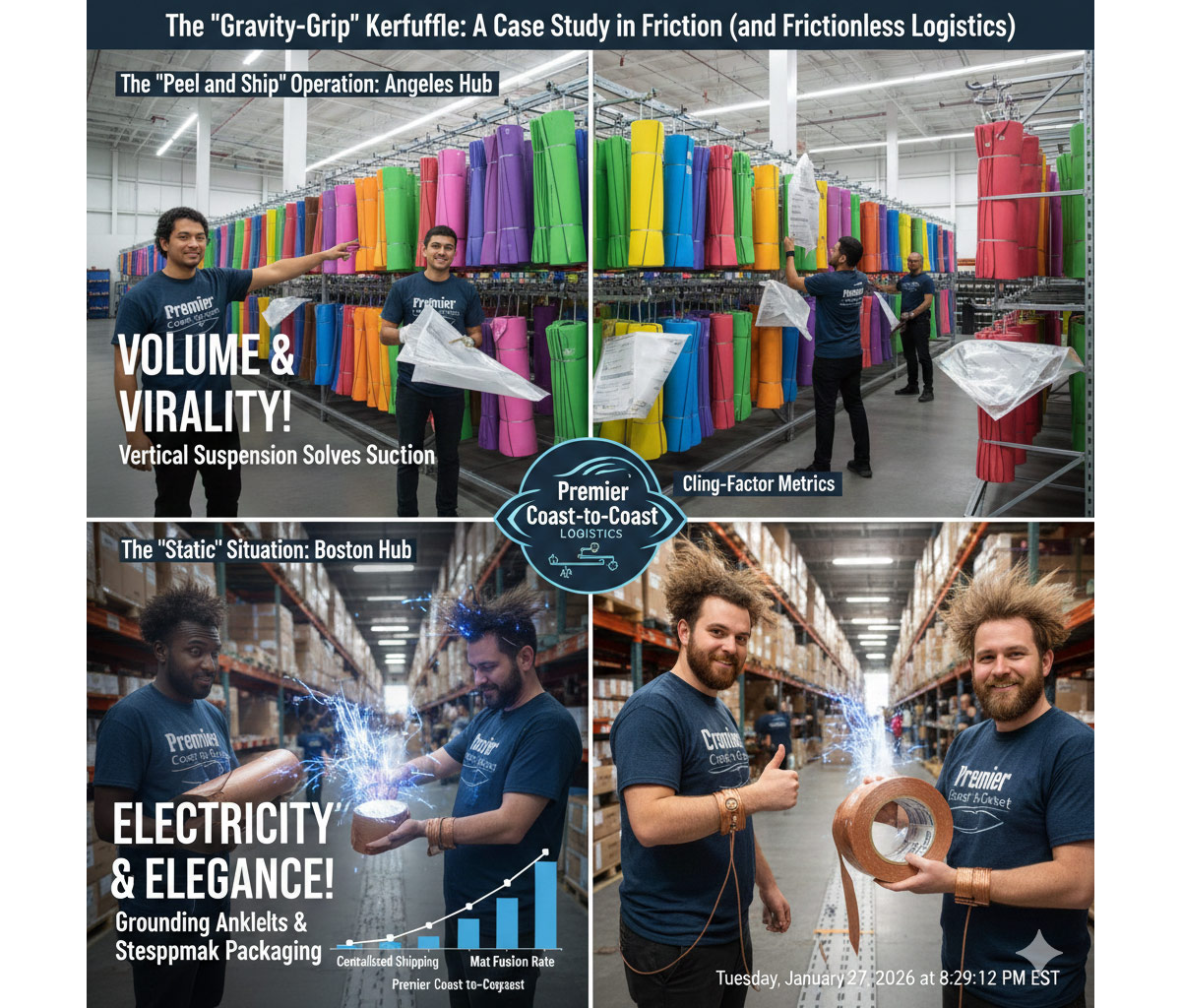
Images of the yoga mat being sold at the warehouse.

As the Marketing Director of Premier Coast-to-Coast Logistics, I’ve spent a lot of time explaining that fulfillment isn’t just “moving boxes.” It’s an art form. It’s a dance. Sometimes, it’s a high-stakes wrestling match with physics.

While most of our clients ship normal things—like shoes that stay in their boxes or books that don’t try to escape—we recently took on a project for a startup that tested the absolute limits of our Los Angeles and Boston facilities.

Enter the Gravity-Grip Infinite Yoga Mat.

The Product: A Material Science “Oopsie”

The folks at Sub-Zero Gravity Labs (fictional, obviously) invented a proprietary material called Static-Foam. The pitch was simple: A yoga mat that uses molecular suction to ensure your hands and feet never slip, regardless of how much you sweat.

The reality? The mat was too good. It didn’t just grip your hands; it gripped everything. If you laid it on a hardwood floor, you needed a crowbar to get it up. If two mats touched each other without a protective barrier, they became one single, inseparable Mega-Mat.

It didn’t need climate control. It didn’t need refrigeration. It just needed to be kept away from literally every other surface in the known universe.

The Strategy: The “Non-Stick” Bi-Coastal Split

The client was based in Sedona but had two massive, clashing demographics: the “Eco-Influencers” of Santa Monica and the “Industrial Loft Minimalists” of Boston’s Seaport District.

Shipping these from a single warehouse in the middle of the country was impossible. Why? Because the vibration of a long-haul truck caused the mats to “settle,” effectively fusing the entire pallet into a 500-pound block of rubber. We had to use our dual-hub system to minimize transit time and maximize “Anti-Cling” protocols.

  1. The Los Angeles Hub: The “Peel and Ship” Operation

In our L.A. facility, the challenge was volume. The West Coast launch went viral on a popular video-sharing app because a famous influencer got her leggings stuck to the mat and had to be cut out of them. Suddenly, everyone wanted one.

  • The Problem: We received 10,000 units of individual mats that were protected only by a thin layer of “De-Ionized Paper.” If that paper ripped, the mat would bond to the warehouse racking.
  • The Solution: Our L.A. team implemented the Vertical Suspension Method. Instead of stacking them, we used specialized hooks to hang the mats like cured meats in a deli.

The Result: We reduced “surface-bond incidents” to zero and maintained a lightning-fast pick-and-pack rate. Because our L.A. warehouse is only miles from the port, we were able to fulfill the “Influencer Wave” in under 24 hours.

  1. The Boston Hub: The “Static” Situation

While L.A. was dealing with volume, Boston was dealing with electricity. The air in a New England warehouse in late autumn is dry. Dry air + Static-Foam = A literal lightning factory.

  • The Problem: Every time a picker grabbed a Gravity-Grip mat, they generated enough static electricity to jump-start a dead car battery. Our team was getting zapped so hard their hair was standing up for three days straight.
  • The Solution: Sully, our Boston floor manager, didn’t panic. He outfitted the entire fulfillment team with Grounding Anklets. We also swapped our standard plastic packing tape for a specialized copper-infused linen tape that neutralized the charge upon contact.

The Result: Not only did we stop the accidental electrocution of our staff, but the copper tape became a “premium packaging feature” that Boston customers loved. It looked “steampunk,” apparently. We fulfilled 8,000 units across the Tri-State area without a single singed eyebrow.

The Fictional Data: Friction vs. Flow

To illustrate how our bi-coastal approach saved this launch, let’s look at the “Cling-Factor” metrics.

MetricCentralized Shipping (Hypothetical)Premier Coast to Coast (Actual)
Transit Time5-7 Days1-2 Days
Mat Fusion Rate12% (Pallets became blocks)0.01% (One mat stuck to a stapler)
Shipping Cost$22.00 per unit (Heavy/Oversized)$9.50 per unit (Local Zone delivery)
Worker Morale"I'm stuck to the floor""I love these grounding anklets"

Why Your Boring Product Deserves This Treatment

You might be shipping coffee beans, phone cases, or artisanal spatulas. Your products probably don’t generate 50,000 volts of electricity or fuse to the walls.

But the logistics principles remain the same:

  1. Zone Skipping Saves Margins: By stocking in L.A. and Boston, you aren’t paying the “Cross-Country Tax.” You’re paying local rates.
  2. Specialized Handling: Every product has a quirk. We don’t just “box it.” We understand it. If your product shouldn’t be stacked, we don’t stack it. If it shouldn’t be shaken, we cradle it.
  3. Scalability: When a product goes viral (for better or worse), you need two engines running, not one. If a blizzard hits Boston, your L.A. hub keeps the revenue flowing.

The Aftermath

The Gravity-Grip Infinite Yoga Mat is now a cult classic. Sub-Zero Gravity Labs is currently developing a “Frictionless Frying Pan” that is so slippery it’s actually illegal in three states.

Our L.A. and Boston teams are already preparing. We’ve ordered a shipment of high-friction gloves and a lot of industrial-strength nets.

Scaling Your Brand Shouldn’t Feel Like a Logistics Nightmare

You’ve done the hard part: you’ve built a brand people love. But as orders pour in, the “behind-the-scenes” can quickly become a bottleneck. If you’re spending more time taping boxes than chasing your next big idea, it’s time to level up.

Why Medallion Fulfillment & Logistics?

  • Bi-Coastal Efficiency: Slash shipping zones and delivery times with strategic warehouse locations that put your product closer to your customers.

  • Seamless Tech Integration: Whether you’re on Shopify, Amazon, or Magento, our system plugs directly into your store for real-time inventory and order tracking.

  • The “Unboxing” Experts: We specialize in custom kitting and high-touch packaging. We don’t just ship products; we deliver your brand’s personality.

  • Scalability on Demand: Whether you’re shipping 100 orders or 100,000, our infrastructure grows with you—no extra overhead required.

Ready to get back to what you do best? Let us handle the heavy lifting. Experience the precision, speed, and personal touch that have made Medallion a leader in eCommerce logistics.

Contact us today for a free price quote!

Why a Family-Owned 3PL is Best for eCommerce Fulfillment

Medallion is your experienced ecommerce fulfillment partner.

Choosing the right fulfillment partner is one of the most critical decisions you will make as a business owner. When your online store starts generating consistent sales, packing boxes in your own facility quickly becomes overwhelming. You need an expert team to take over the heavy lifting, allowing you to focus on marketing and product development.

Many growing businesses instinctively look toward massive, corporate logistics providers. These mega-warehouses promise efficiency but frequently treat small and medium-sized enterprises as just another account number. You might experience rigid service agreements, hidden fees, and automated support channels that leave you frustrated when shipping issues arise.

Partnering with a family-owned 3PL ecommerce fulfillment company offers a distinctly different experience. A family-operated 3PL logistics provider brings a unique level of care, flexibility, and stability to your supply chain operations. By understanding these advantages, you can make an informed decision that protects your brand reputation and supports sustainable business growth.

The Problem with Corporate Logistics

When you outsource your shipping to a massive corporate provider, you often sacrifice personalized support. Large fulfillment corporations answer to shareholders and boards of directors. Their primary goal is to maximize their own profit margins, which frequently results in rigid policies and a lack of flexibility for your specific needs.

Customer service quality from your 3PL directly impacts your brand reputation. When a customer receives the wrong item or experiences a delayed shipment, they do not blame the warehouse. They blame your business. If your fulfillment provider relies on slow, automated ticketing systems to resolve these errors, your customer satisfaction will plummet.

The Family Business Difference

Family-owned 3PL logistics companies operate with a completely different mindset. Because we are not beholden to distant shareholders, we make decisions at the ground level based on what actually works for your business. We know that if our clients are successful, our own business will thrive.

Unmatched Customer Commitment

A family-owned fulfillment warehouse prioritizes personal attention. At Medallion Fulfillment & Logistics, we started out in the Kent family garage over 30 years ago. Today, we have grown into a national enterprise, but we hold tight to that original focus on exceptional customer service and responsiveness. When you have a question or a unique shipping requirement, you can speak directly to a fulfillment expert who understands your account. Responsive support means issues are resolved quickly, keeping your buyers happy and protecting your hard-earned reputation.

Long-Term Stability

Corporate 3PLs frequently shift their business models or pivot to new software platforms, causing massive disruptions for their clients. Family businesses tend to have a much more stable, long-term focus. We provide a consistent level of service year after year. You do not have to worry about sudden shifts in management or unexpected policy changes that threaten your daily operations.

Flexibility and Scalable Services

Your order volume will naturally fluctuate throughout the year. You might launch a highly successful marketing campaign that spikes your sales, or you might experience a quiet season. A family-operated 3PL offers scalable ecommerce fulfillment services that adapt to these changes. We offer start-up programs for newer businesses and have the infrastructure to scale seamlessly as your daily order volume grows.

Key Fulfillment Services That Drive Growth

A commitment to family values does not mean sacrificing modern technology or nationwide reach. An experienced 3PL logistics provider combines personalized care with the advanced tools necessary to compete in the modern digital marketplace.

Coast-to-Coast Warehousing

Speed and reliability are non-negotiable for online shoppers. If you ship all your orders from a single location, customers on the other side of the country will experience long wait times and high shipping costs. We operate East Coast and West Coast fulfillment warehouse locations in Boston and Los Angeles. This coast-to-coast presence ensures your shipping costs stay low while delivering merchandise to your customers nationwide incredibly fast.

Seamless Shopping Cart Integrations

Manual order entry leads to costly mistakes and wasted time. Our software innovation allows for full integration with the most popular third-party shopping carts. Once connected, your orders flow directly to our warehouse floor for fast, accurate picking and packing.

Amazon Stock Replenishment and Returns

Managing inventory across multiple sales channels requires serious organization. We offer dedicated Amazon Stock Warehouse Replenishment services to ensure you never run out of inventory at crucial FBA centers. Additionally, we handle the entire returns process. Streamlining returns makes the experience effortless for your customers while minimizing your costs and time investment.

Let the Experts Handle Your Shipping

Selling is what you know and love. Spending your valuable time boxing up orders and printing shipping labels holds your business back from reaching its true potential. An experienced fulfillment warehouse offers distinct advantages, such as excellent relationships with carriers to keep shipping costs down, while providing superior service to your customers.

Keep your online shop running smoothly around the clock. Complete our free quote form today to learn more about our innovative, cost-effective solutions at Medallion Fulfillment & Logistics. Let our family-owned 3PL help your business reach the next level.