
The “Gravity-Grip” Kerfuffle: A Case Study in Friction (and Frictionless Logistics)

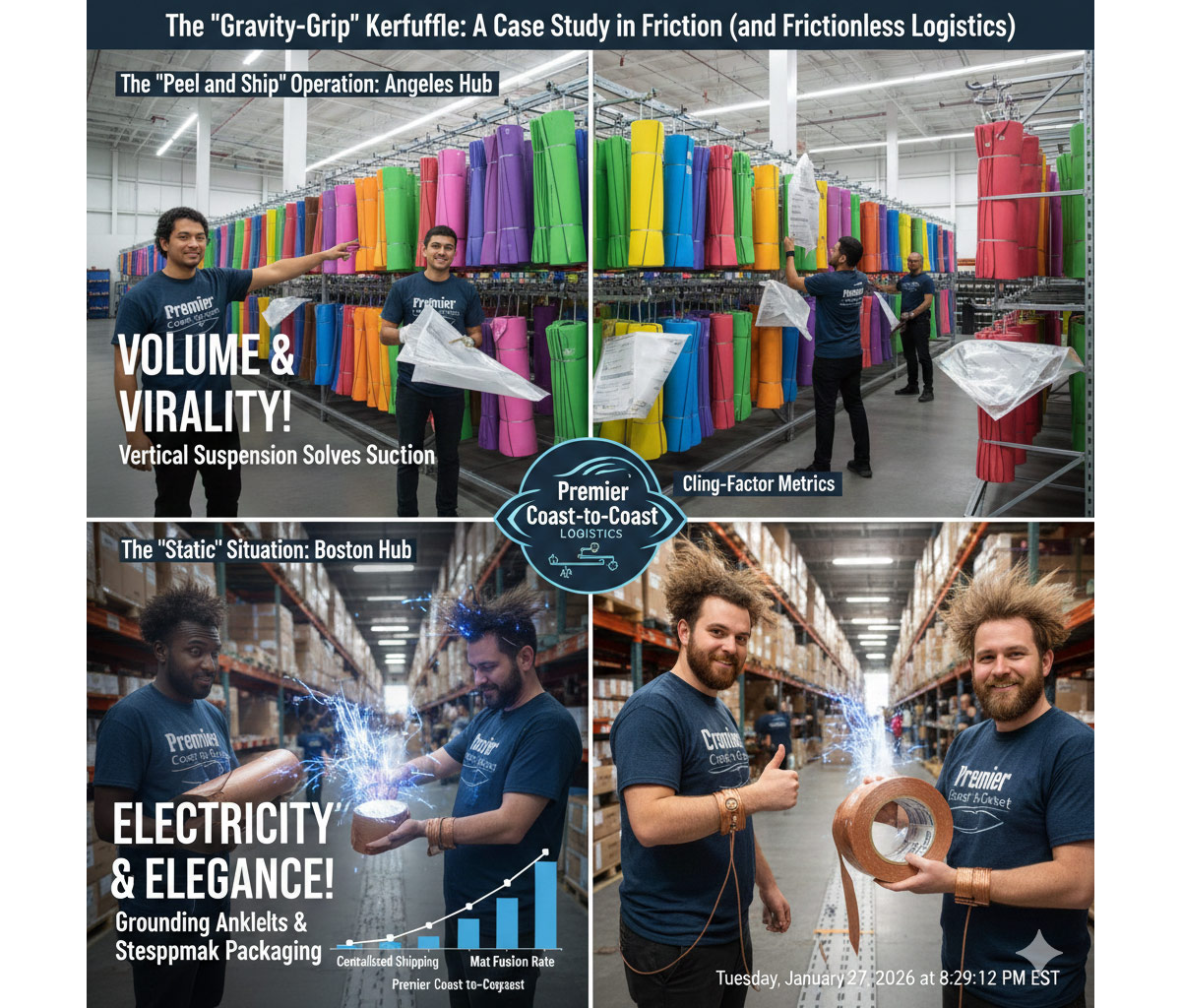
Images of the yoga mat being sold at the warehouse.

As the Marketing Director of Premier Coast-to-Coast Logistics, I’ve spent a lot of time explaining that fulfillment isn’t just “moving boxes.” It’s an art form. It’s a dance. Sometimes, it’s a high-stakes wrestling match with physics.

While most of our clients ship normal things—like shoes that stay in their boxes or books that don’t try to escape—we recently took on a project for a startup that tested the absolute limits of our Los Angeles and Boston facilities.

Enter the Gravity-Grip Infinite Yoga Mat.

The Product: A Material Science “Oopsie”

The folks at Sub-Zero Gravity Labs (fictional, obviously) invented a proprietary material called Static-Foam. The pitch was simple: A yoga mat that uses molecular suction to ensure your hands and feet never slip, regardless of how much you sweat.

The reality? The mat was too good. It didn’t just grip your hands; it gripped everything. If you laid it on a hardwood floor, you needed a crowbar to get it up. If two mats touched each other without a protective barrier, they became one single, inseparable Mega-Mat.

It didn’t need climate control. It didn’t need refrigeration. It just needed to be kept away from literally every other surface in the known universe.

The Strategy: The “Non-Stick” Bi-Coastal Split

The client was based in Sedona but had two massive, clashing demographics: the “Eco-Influencers” of Santa Monica and the “Industrial Loft Minimalists” of Boston’s Seaport District.

Shipping these from a single warehouse in the middle of the country was impossible. Why? Because the vibration of a long-haul truck caused the mats to “settle,” effectively fusing the entire pallet into a 500-pound block of rubber. We had to use our dual-hub system to minimize transit time and maximize “Anti-Cling” protocols.

  1. The Los Angeles Hub: The “Peel and Ship” Operation

In our L.A. facility, the challenge was volume. The West Coast launch went viral on a popular video-sharing app because a famous influencer got her leggings stuck to the mat and had to be cut out of them. Suddenly, everyone wanted one.

  • The Problem: We received 10,000 units of individual mats that were protected only by a thin layer of “De-Ionized Paper.” If that paper ripped, the mat would bond to the warehouse racking.
  • The Solution: Our L.A. team implemented the Vertical Suspension Method. Instead of stacking them, we used specialized hooks to hang the mats like cured meats in a deli.

The Result: We reduced “surface-bond incidents” to zero and maintained a lightning-fast pick-and-pack rate. Because our L.A. warehouse is only miles from the port, we were able to fulfill the “Influencer Wave” in under 24 hours.

  1. The Boston Hub: The “Static” Situation

While L.A. was dealing with volume, Boston was dealing with electricity. The air in a New England warehouse in late autumn is dry. Dry air + Static-Foam = A literal lightning factory.

  • The Problem: Every time a picker grabbed a Gravity-Grip mat, they generated enough static electricity to jump-start a dead car battery. Our team was getting zapped so hard their hair was standing up for three days straight.
  • The Solution: Sully, our Boston floor manager, didn’t panic. He outfitted the entire fulfillment team with Grounding Anklets. We also swapped our standard plastic packing tape for a specialized copper-infused linen tape that neutralized the charge upon contact.

The Result: Not only did we stop the accidental electrocution of our staff, but the copper tape became a “premium packaging feature” that Boston customers loved. It looked “steampunk,” apparently. We fulfilled 8,000 units across the Tri-State area without a single singed eyebrow.

The Fictional Data: Friction vs. Flow

To illustrate how our bi-coastal approach saved this launch, let’s look at the “Cling-Factor” metrics.

MetricCentralized Shipping (Hypothetical)Premier Coast to Coast (Actual)
Transit Time5-7 Days1-2 Days
Mat Fusion Rate12% (Pallets became blocks)0.01% (One mat stuck to a stapler)
Shipping Cost$22.00 per unit (Heavy/Oversized)$9.50 per unit (Local Zone delivery)
Worker Morale"I'm stuck to the floor""I love these grounding anklets"

Why Your Boring Product Deserves This Treatment

You might be shipping coffee beans, phone cases, or artisanal spatulas. Your products probably don’t generate 50,000 volts of electricity or fuse to the walls.

But the logistics principles remain the same:

  1. Zone Skipping Saves Margins: By stocking in L.A. and Boston, you aren’t paying the “Cross-Country Tax.” You’re paying local rates.
  2. Specialized Handling: Every product has a quirk. We don’t just “box it.” We understand it. If your product shouldn’t be stacked, we don’t stack it. If it shouldn’t be shaken, we cradle it.
  3. Scalability: When a product goes viral (for better or worse), you need two engines running, not one. If a blizzard hits Boston, your L.A. hub keeps the revenue flowing.

The Aftermath

The Gravity-Grip Infinite Yoga Mat is now a cult classic. Sub-Zero Gravity Labs is currently developing a “Frictionless Frying Pan” that is so slippery it’s actually illegal in three states.

Our L.A. and Boston teams are already preparing. We’ve ordered a shipment of high-friction gloves and a lot of industrial-strength nets.

Scaling Your Brand Shouldn’t Feel Like a Logistics Nightmare

You’ve done the hard part: you’ve built a brand people love. But as orders pour in, the “behind-the-scenes” can quickly become a bottleneck. If you’re spending more time taping boxes than chasing your next big idea, it’s time to level up.

Why Medallion Fulfillment & Logistics?

  • Bi-Coastal Efficiency: Slash shipping zones and delivery times with strategic warehouse locations that put your product closer to your customers.

  • Seamless Tech Integration: Whether you’re on Shopify, Amazon, or Magento, our system plugs directly into your store for real-time inventory and order tracking.

  • The “Unboxing” Experts: We specialize in custom kitting and high-touch packaging. We don’t just ship products; we deliver your brand’s personality.

  • Scalability on Demand: Whether you’re shipping 100 orders or 100,000, our infrastructure grows with you—no extra overhead required.

Ready to get back to what you do best? Let us handle the heavy lifting. Experience the precision, speed, and personal touch that have made Medallion a leader in eCommerce logistics.


Contact us today for a free price quote!

The Calm Before the Climb: Why February is the Month to Stress-Test Your Supply Chain

Planning for Seasonal Activity is Key for the Spring

If you feel like you’ve just finally caught your breath after the Q4 holiday madness and the January return cycle, you aren’t alone. For many e-commerce brands and retailers, February feels like a hard-earned plateau. But as we near into the second week of February, that “quiet” is a bit deceptive.

In the logistics world, February is the “sweet spot.” It’s the eye of the storm. Behind the scenes, consumer behavior is already shifting. People are looking toward spring breaks, warmer weather, Valentine’s Day, and the start of the outdoor season.

If you wait until the orders start spiking in March or April to look at your processes, you’re already behind. At Medallion Fulfillment & Logistics, we’ve seen it time and again: success in Q1 isn’t won in March—it’s engineered right now.

Here is how to stress-test your supply chain this month to ensure you don’t just survive the Q2 surge, but actually thrive through it.

  1. The Marketing-Logistics “Handshake”

As a Marketing Director, you know better than anyone that a brilliant campaign is only as good as the customer’s unboxing experience. You can spend thousands on customer acquisition, but if the product arrives late—or worse, not at all—that customer is gone for good.

February is the time for the “Great Alignment.” Often, the marketing department is running a mile a minute planning “Spring Fling” promos, while the operations team is just trying to keep the shelves organized.

The Stress Test: Sit down with your fulfillment partner (that’s us!) and walk through your promotional calendar for planning for April, May, and June.

Flash Sales: Are you planning a 24-hour “blowout”? We need to staff up for that 48-hour window following the launch.

New Product Launches: Are there kits or bundles involved? These require different picking logic and potentially extra assembly time.

Expectation Management: When marketing and logistics talk, you can set realistic shipping expectations on your website before the customer hits “buy.”

  1. Inventory Hygiene: Clearing the “Zombie” Stock

Inventory isn’t just products on a shelf; it’s capital tied up in a physical form. During the Q2 surge, warehouse “real estate” becomes incredibly valuable. You want your high-velocity spring items in the most accessible “pick zones,” not tucked away behind boxes of leftover winter gear.

The Stress Test: Perform an inventory “Velocity Audit.”

Look for the “Zombies”—the SKUs that haven’t moved in 60 to 90 days. They are eating your margins in storage fees and physically slowing down the fulfillment of your winners.

The March Solution: Run a “End of Season” clearance in mid-March. Liquidate the laggards to make room for the Q2 heroes. This injects cash back into your business right when you need it for spring ad spend.

  1. The “Fragile” Link: Supplier and Inbound Health

Even if your warehouse is running like a Swiss watch, you’re still at the mercy of your upstream suppliers. We’ve all seen how a single port delay or a raw material shortage can derail an entire season.

The Stress Test: Don’t just check your current stock; check your inbound pipeline.

Buffer Stock: If you’re expecting a 20% jump in sales for Q2, do you have a 30% buffer?

Diversification: If all your eggs are in one supplier’s basket, March is the time to identify a “Plan B.”

Communication: Reach out to your manufacturers now. Ask them about their lead times. If they are seeing delays, you can adjust your marketing spend in March to avoid promoting items that won’t arrive until June.

  1. Digital Infrastructure: Is Your Tech Stack Talking?

In a low-volume month, a manual error—like an order not syncing or a tracking number failing to upload—is a minor nuisance. In a high-volume Q2 surge, that same error can snowball into hundreds of customer service tickets.

The Stress Test: Review your tech integrations.

At Medallion, we use sophisticated Warehouse Management Systems (WMS) that talk to your Shopify, Amazon, or BigCommerce stores. But “set it and forget it” is a dangerous mantra.

Data Sync Check: Are your inventory levels matching up across all platforms?

Shipping Rules: Have you updated your shipping carriers or methods for the new season?

Automated Emails: Are your “Order Shipped” notifications providing the right tracking links? Small digital tweaks in March prevent massive headaches in May.

  1. The Human Element: Customer Experience is the New Marketing

In the age of instant gratification, shipping is no longer a back-end cost; it’s a front-facing marketing feature. People don’t just buy a product; they buy the confidence that it will arrive in time for their vacation or their Mother’s Day brunch.

The Stress Test: Evaluate your packaging and “unboxing” experience.

Sustainability: Spring is a great time to pivot to more eco-friendly packaging. Does your current dunnage reflect your brand values?

The “Wow” Factor: Can you include a simple spring-themed pack-in or a discount code for their next Q3 purchase?

Final Thoughts: Don’t Wait for the Heat

The Q2 surge is coming. The brands that win are the ones that use the quiet weeks of March to tighten their laces, audit their shelves, and talk to their partners.

At Medallion Fulfillment & Logistics, we don’t just want to ship your boxes; we want to help you scale your brand. Our infrastructure is built to handle your growth, but the best results happen when we plan that growth together.

Let’s make sure your supply chain is a springboard, not a bottleneck for your ecommerce fulfillment.

Are you ready for the climb? Reach out to your account manager this week to discuss your Q1 and Q2 projections, and let’s get ahead of the curve together.


Is Your Ecommerce Traffic Down? Here’s How to Fix It Fast

Representation of AI overview and how it relates to website traffic drops

You check your analytics dashboard, and your heart sinks. The numbers are red. The steady stream of visitors you relied on last quarter has turned into a trickle. For any business owner, a sudden drop in web traffic isn’t just a vanity metric problem—it’s a direct hit to your revenue and growth goals.

It’s a scenario we see often. You spend months building a beautiful online store and optimizing your products, only to see engagement stall. While organic growth is the holy grail, relying solely on it can leave you vulnerable to search engine whims and aggressive competitors.

If you’re wondering where your customers went, you aren’t alone. But waiting for them to come back isn’t a strategy. To regain control and drive consistent sales, you need to pivot from passive waiting to active acquisition. Here is why your traffic might be down and how paid ecommerce marketing can turn the tide.

Common Reasons for Declining Web Traffic

Before you can fix the problem, you have to diagnose it. Traffic drops rarely happen without a reason. Usually, it is a combination of external factors and internal gaps.

Algorithm Updates

Search engines like Google are constantly refining how they rank websites. A “core update” can happen overnight, shuffling search results and pushing your once-dominant product pages to page two or three. If your organic traffic plummeted on a specific date, an algorithm change is often the culprit.

Increased Competition

The barrier to entry for ecommerce is lower than ever. New competitors enter the market daily, bidding on the same keywords and targeting the same audience. If a competitor launches an aggressive ad campaign or undercuts your pricing, they can siphon off your traffic before it even reaches your site.

Seasonal Changes

Consumer behavior ebbs and flows. A swimsuit retailer naturally sees a dip in October, while a gift shop peaks in December. Failing to account for these natural cycles can make a normal seasonal lull feel like a crisis.

Technical and SEO Issues

Sometimes the call is coming from inside the house. Broken links, slow page load speeds, or accidental changes to your site’s structure can prevent search engines from crawling your pages correctly. If Google can’t read your site, it won’t show it to customers.

Search Generative Content and AI Overviews

The rise of search generative content (SGC) and artificial intelligence (AI) overviews is reshaping how information is presented in search engine results pages (SERPs). Tools like Google’s AI-generated summaries aim to provide users with immediate, synthesized answers to their queries, often before traditional organic results appear. While this offers convenience for users, it pushes valuable organic results further down the page, reducing visibility and click-through rates for businesses.

For business owners, this means adapting their SEO strategies to account for the growing presence of AI-driven content. Focusing on targeted keywords, optimizing for featured snippets, and incorporating high-quality, actionable information can help ensure your content remains competitive. Businesses also benefit from creating authoritative and value-rich content that AI overviews are more likely to reference directly. Staying proactive in this shifting landscape is crucial to maintaining a strong digital presence.

The Power of Paid Advertising

When organic traffic falters, paid advertising is the engine that gets you moving again. Unlike SEO, which takes months to build, paid ads offer a faucet you can turn on immediately.

For ecommerce businesses, the benefits are clear:

  • Immediate Visibility: You can appear at the top of search results or in social feeds within hours of launching a campaign.
  • Precision Targeting: You don’t have to wait for customers to find you. You can target specific demographics, interests, and buying behaviors.
  • Measurable Results: Every dollar is tracked. You know exactly which ads are driving sales and what your return on investment (ROI) is.
  • Scalability: Once you find a winning formula, you can increase your budget to scale traffic instantly which is perfect for when you have excess inventory to move.

Effective Paid Advertising Strategies

Not all ads are created equal. To get the best return on your ad spend, you need to choose the right channels for your products.

Google Shopping and Search Ads

For ecommerce, Google is often the highest-converting channel because it captures high-intent buyers.

  • Google Shopping: These are the visual product listings that appear at the top of search results. They display your product image, price, and store name immediately. Success here relies on a healthy product feed—ensuring attributes like [price], [availability], and [image_link] are accurate in your Merchant Center.
  • Search Ads: These text-based ads target specific keywords. If you sell “organic dog treats,” you can bid to appear when someone types that exact phrase.

Social Media Advertising

Platforms like Facebook and Instagram are excellent for generating demand. Tools like Meta’s Advantage+ Shopping campaigns use machine learning to automate ad delivery, showing your catalog to the people most likely to buy, even if they haven’t heard of your brand yet.

Retargeting Campaigns

Most visitors won’t buy on their first visit. Retargeting allows you to show ads to people who viewed a product but left without purchasing. These ads serve as a gentle reminder, often bringing customers back to complete the checkout process.

Optimizing Your Paid Advertising Campaigns

Throwing money at Google or Facebook isn’t a guaranteed fix. In fact, without the proper know how, paid ads can quickly become a money pit.

Effective management involves:

  • Continuous Testing: A/B testing headlines, images, and offers to see what resonates.
  • Negative Keywords: Telling Google where not to show your ads (e.g., preventing your premium product from showing up for “cheap” or “free” search terms) to save budget.
  • Audience Refinement: Constantly tweaking who sees your ads to improve conversion rates.

Because the landscape changes so fast—with new features like Performance Max and Advantage+ rolling out regularly—many business owners find it more cost-effective to partner with a dedicated marketing expert rather than trying to DIY their ad strategy.

Working With Medallion Fulfillment for Order Fulfillment

Driving traffic is only the first half of the equation. Once those orders start rolling in from your new ad campaigns, you need a backend that can handle the volume.

At Medallion Fulfillment & Logistics, we know that marketing and operations go hand-in-hand. There is nothing worse than paying for a customer only to lose them due to slow shipping or inventory errors. We provide the scalable ecommerce order fulfillment infrastructure you need to support aggressive growth.

Furthermore, we believe in a holistic approach to business growth. We encourage our clients to work with specialized partners who can handle the complexities of paid ecommerce marketing. By aligning your order fulfillment logistics with a dedicated marketing team, you ensure that your business is firing on all cylinders—generating sales on the front end and delivering five-star experiences on the back end.

Turn Traffic Drops into Sales Spikes

A drop in traffic is a wake-up call, not a death sentence. By diversifying your strategy and integrating paid advertising, you can insulate your business from algorithm updates and seasonal slumps.

Don’t let your inventory sit stagnant while you wait for organic rankings to recover. Take control of your traffic today.

If you are ready to scale your operations to meet renewed demand, contact us at Medallion Fulfillment & Logistics. Let’s discuss how our innovative, cost-effective solutions can support your growth journey.

Prepare Your Ecommerce Store for Growth in 2026 with These Winning Strategies

Prepare for a winning ecommerce store strategy.

The Ecommerce industry is constantly evolving, and 2026 will be no exception. Are you ready to embrace the future? Let our ecommerce fulfillment warehouse staff help you stay ahead of the competition by sharing the biggest trends that will be shaping Ecommerce over the next 12 months.

1. Leveraging social media as a selling platform

Instagram, Facebook, and TikTok have long been powerful marketing and communication tools. Savvy Ecommerce retailers are taking it one step further by using them as comprehensive sales channels that allow customers to complete purchases right in the app. If you’ve been lagging in building a strong social media commerce strategy, don’t wait any longer.

2. Offering same-day delivery

Same-day delivery is the new standard. Thanks to services such as DoorDash, Postmates, and InstaCart, consumers have now become accustomed to receiving orders on demand. Streamline your logistics and do your research to make sure you partner with a trustworthy courier service to meet these lightning-fast expectations.

3. Using artificial intelligence and machine learning to personalize the customer experience

Now that artificial intelligence (AI) and machine learning are firmly established, there are virtually no limits to how effectively you can tailor the online purchasing experience. Use this cutting-edge technology to customize everything from product recommendations and marketing campaigns to customer service and catboats. This not only increases customer satisfaction but also boosts loyalty and retention rates.

Personalization is key to capturing the attention of your target audience in today’s fast-paced digital landscape. By leveraging AI and machine learning, you can gather valuable data on customer behavior and preferences, allowing you to create highly targeted campaigns that are more likely to convert. Additionally, with chatbots becoming increasingly sophisticated, customers can receive personalized support 24/7 without the need for human intervention.

4. Optimizing voice-activated shopping

Alexa and Siri have gone from fun novelties to dependable “assistants.” Experts predict a continued sharp increase in voice-activated shopping during 2026. Here are some helpful tips to optimize this tool in your Ecommerce business:

  • Focus on natural and conversational voice patterns.
  • Incorporate long-tail keywords coinciding with voice-search queries.
  • Provide informative but concise answers. If you have a tutorial or blog post that answers the query, Alexa will provide users with your URL.
  • Optimize local search terms to drive local voice-search traffic.
  • Use schema markup to improve visibility in voice search results.

Voice-activated shopping is not just about convenience. It also presents an opportunity for businesses to build brand recognition and loyalty. By optimizing for this growing trend, you can attract new customers and keep them coming back.

Medallion: An Ecommerce Fulfillment Warehouse for the Present and Future

With decades of experience, Medallion Fulfillment & Logistics has the ability to successfully pivot with all of the industry changes and innovations. Contact us today to learn more.

Why a Family-Owned 3PL is Best for eCommerce Fulfillment

Medallion is your experienced ecommerce fulfillment partner.

Choosing the right fulfillment partner is one of the most critical decisions you will make as a business owner. When your online store starts generating consistent sales, packing boxes in your own facility quickly becomes overwhelming. You need an expert team to take over the heavy lifting, allowing you to focus on marketing and product development.

Many growing businesses instinctively look toward massive, corporate logistics providers. These mega-warehouses promise efficiency but frequently treat small and medium-sized enterprises as just another account number. You might experience rigid service agreements, hidden fees, and automated support channels that leave you frustrated when shipping issues arise.

Partnering with a family-owned 3PL ecommerce fulfillment company offers a distinctly different experience. A family-operated 3PL logistics provider brings a unique level of care, flexibility, and stability to your supply chain operations. By understanding these advantages, you can make an informed decision that protects your brand reputation and supports sustainable business growth.

The Problem with Corporate Logistics

When you outsource your shipping to a massive corporate provider, you often sacrifice personalized support. Large fulfillment corporations answer to shareholders and boards of directors. Their primary goal is to maximize their own profit margins, which frequently results in rigid policies and a lack of flexibility for your specific needs.

Customer service quality from your 3PL directly impacts your brand reputation. When a customer receives the wrong item or experiences a delayed shipment, they do not blame the warehouse. They blame your business. If your fulfillment provider relies on slow, automated ticketing systems to resolve these errors, your customer satisfaction will plummet.

The Family Business Difference

Family-owned 3PL logistics companies operate with a completely different mindset. Because we are not beholden to distant shareholders, we make decisions at the ground level based on what actually works for your business. We know that if our clients are successful, our own business will thrive.

Unmatched Customer Commitment

A family-owned fulfillment warehouse prioritizes personal attention. At Medallion Fulfillment & Logistics, we started out in the Kent family garage over 30 years ago. Today, we have grown into a national enterprise, but we hold tight to that original focus on exceptional customer service and responsiveness. When you have a question or a unique shipping requirement, you can speak directly to a fulfillment expert who understands your account. Responsive support means issues are resolved quickly, keeping your buyers happy and protecting your hard-earned reputation.

Long-Term Stability

Corporate 3PLs frequently shift their business models or pivot to new software platforms, causing massive disruptions for their clients. Family businesses tend to have a much more stable, long-term focus. We provide a consistent level of service year after year. You do not have to worry about sudden shifts in management or unexpected policy changes that threaten your daily operations.

Flexibility and Scalable Services

Your order volume will naturally fluctuate throughout the year. You might launch a highly successful marketing campaign that spikes your sales, or you might experience a quiet season. A family-operated 3PL offers scalable ecommerce fulfillment services that adapt to these changes. We offer start-up programs for newer businesses and have the infrastructure to scale seamlessly as your daily order volume grows.

Key Fulfillment Services That Drive Growth

A commitment to family values does not mean sacrificing modern technology or nationwide reach. An experienced 3PL logistics provider combines personalized care with the advanced tools necessary to compete in the modern digital marketplace.

Coast-to-Coast Warehousing

Speed and reliability are non-negotiable for online shoppers. If you ship all your orders from a single location, customers on the other side of the country will experience long wait times and high shipping costs. We operate East Coast and West Coast fulfillment warehouse locations in Boston and Los Angeles. This coast-to-coast presence ensures your shipping costs stay low while delivering merchandise to your customers nationwide incredibly fast.

Seamless Shopping Cart Integrations

Manual order entry leads to costly mistakes and wasted time. Our software innovation allows for full integration with the most popular third-party shopping carts. Once connected, your orders flow directly to our warehouse floor for fast, accurate picking and packing.

Amazon Stock Replenishment and Returns

Managing inventory across multiple sales channels requires serious organization. We offer dedicated Amazon Stock Warehouse Replenishment services to ensure you never run out of inventory at crucial FBA centers. Additionally, we handle the entire returns process. Streamlining returns makes the experience effortless for your customers while minimizing your costs and time investment.

Let the Experts Handle Your Shipping

Selling is what you know and love. Spending your valuable time boxing up orders and printing shipping labels holds your business back from reaching its true potential. An experienced fulfillment warehouse offers distinct advantages, such as excellent relationships with carriers to keep shipping costs down, while providing superior service to your customers.

Keep your online shop running smoothly around the clock. Complete our free quote form today to learn more about our innovative, cost-effective solutions at Medallion Fulfillment & Logistics. Let our family-owned 3PL help your business reach the next level.