Slash Shipping Costs with Bi-Coastal Fulfillment and Warehousing

Logistics and Bi-Coastal Fulfillment shipping concepts. Responsible transportation and delivery of products. Blurred background of a ship unloading containers

For any business owner, the equation is simple: high shipping costs equal lower margins. As your customer base grows across the country, so does the complexity—and the price tag—of getting your products into their hands. If you are shipping from a single warehouse on one coast to a customer on the other, you are likely feeling the sting of “Zone 8” shipping rates. 

But there is a better way. By strategically splitting your inventory between the East and West Coasts, you can drastically reduce transit times and keep more profit in your pocket. Here is how a bi-coastal fulfillment strategy can transform your logistics from a cost center into a competitive advantage. 

The Hidden Cost of Shipping: Why “Zone 8” is Killing Your Margins 

In the world of logistics, distance is money. Carriers like UPS, FedEx, and USPS divide the U.S. into shipping zones, ranging from Zone 1 (local) to Zone 8 (farthest distance). The further a package travels, the higher the zone, and the more you pay. 

If your single warehouse is in Los Angeles and you ship a package to New York, that is a Zone 8 shipment. It is the most expensive domestic rate you can pay, often costing significantly more than a local delivery. 

Beyond the financial cost, there is the cost of time. A cross-country ground shipment can take 5+ days. In an era where two-day delivery is the standard set by retail giants, asking a customer to wait nearly a week can lead to cart abandonment and lost sales. Today’s consumers expect speed, and they expect it to be free or affordable. Relying on a single distribution point makes meeting those expectations incredibly difficult without eroding your bottom line. 

East Coast Meets West Coast: The Power of Proximity 

The solution to the Zone 8 problem is simple geography. By utilizing bi-coastal fulfillment, you place your inventory closer to your customers, regardless of where they live. 

At Medallion Fulfillment & Logistics, we offer established warehousing facilities in both Los Angeles and Boston. This dual footprint allows you to reach the vast majority of the U.S. population within just a few days via affordable ground shipping. 

  • West Coast Orders: Fulfilled from our Los Angeles facility, reaching customers in California, Oregon, Washington, and surrounding states in Zones 1–4. 
  • East Coast Orders: Fulfilled from our Boston facility, quickly reaching the densely populated Northeast and Eastern seaboard. 

This strategy effectively eliminates most Zone 7 and Zone 8 shipments. Instead of paying premium rates to ship across the country, you are paying lower local or regional rates. The result? You slash your shipping costs per order and deliver products faster. It is a win-win that improves your customer experience while protecting your margins. 

Technology That Plays Nice 

Moving to a 3PL (Third-Party Logistics) provider or expanding to a second warehouse often raises concerns about technical headaches. Will the inventory sync? Will orders get routed to the right warehouse automatically? 

We have taken the complexity out of the equation. Medallion’s advanced software integrates seamlessly with the most popular shopping carts, including Shopify, Amazon, and WooCommerce. 

Our system acts as a central command center for your inventory. When an order comes in, our technology determines the most efficient shipping origin based on the customer’s delivery address. It automatically routes the order to the warehouse that can get it there fastest and cheapest. You don’t have to manually sort orders or juggle spreadsheets; our integrations handle the heavy lifting so you can focus on selling. You just need to ensure that you have stocked both warehouses with your inventory. 

Scalability for the “Big Moments” 

Every business owner dreams of the viral moment—the sudden spike in sales that puts your brand on the map. But from a logistics standpoint, that dream can quickly become a nightmare if you are fulfilling orders from your own garage or a small, inflexible warehouse. 

One of the biggest advantages of partnering with an established 3PL like Medallion is scalability. We have the infrastructure, staffing, and space to handle your peaks, whether they are seasonal holiday rushes or unexpected growth spurts. 

When you manage your own fulfillment, a spike in sales means late nights packing boxes and frantically hiring temporary help. With Medallion, it just means business as usual. We scale our labor and operations to meet your demand, ensuring your orders go out on time, every time. You get the flexibility to grow without the overhead risk of leasing your own larger facility or hiring permanent staff. 

Personal Touch in a Digital World 

In an industry increasingly dominated by faceless tech giants and automated support bots, Medallion remains proudly family-owned and operated. We started in a family garage, just like many of the businesses we serve, and we have grown into a national enterprise without losing our roots. 

We understand that your inventory is your livelihood. When you call us, you are not just a ticket number; you are a partner. We pride ourselves on responsiveness and personal service. If you have a question about a shipment or need to troubleshoot an issue, you can reach a real person who knows your business and cares about your success. 

Ready to optimize your logistics? 

If you are tired of watching your profits disappear into shipping fees, it is time to evaluate your fulfillment strategy. A bi-coastal approach is not just for Fortune 500 companies; it is a practical, accessible solution for growing businesses looking to compete on speed and price. 

Don’t let logistics hold your business back. Contact us today for a free price quote or a “logistics health check” to see exactly how much you could save by partnering with Medallion Fulfillment & Logistics. 

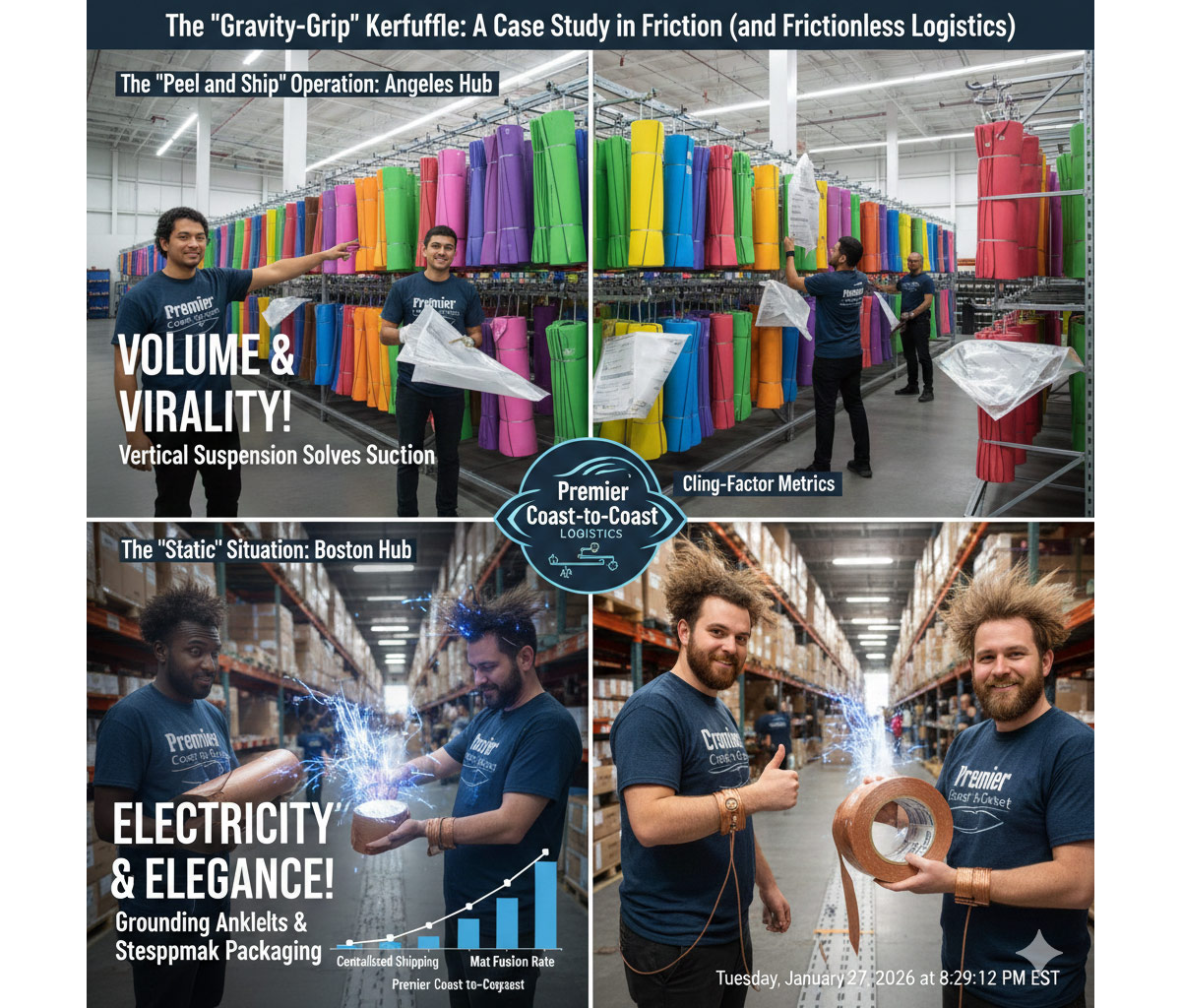
The “Gravity-Grip” Kerfuffle: A Case Study in Friction (and Frictionless Logistics)

Images of the yoga mat being sold at the warehouse.

As the Marketing Director of Premier Coast-to-Coast Logistics, I’ve spent a lot of time explaining that fulfillment isn’t just “moving boxes.” It’s an art form. It’s a dance. Sometimes, it’s a high-stakes wrestling match with physics.

While most of our clients ship normal things—like shoes that stay in their boxes or books that don’t try to escape—we recently took on a project for a startup that tested the absolute limits of our Los Angeles and Boston facilities.

Enter the Gravity-Grip Infinite Yoga Mat.

The Product: A Material Science “Oopsie”

The folks at Sub-Zero Gravity Labs (fictional, obviously) invented a proprietary material called Static-Foam. The pitch was simple: A yoga mat that uses molecular suction to ensure your hands and feet never slip, regardless of how much you sweat.

The reality? The mat was too good. It didn’t just grip your hands; it gripped everything. If you laid it on a hardwood floor, you needed a crowbar to get it up. If two mats touched each other without a protective barrier, they became one single, inseparable Mega-Mat.

It didn’t need climate control. It didn’t need refrigeration. It just needed to be kept away from literally every other surface in the known universe.

The Strategy: The “Non-Stick” Bi-Coastal Split

The client was based in Sedona but had two massive, clashing demographics: the “Eco-Influencers” of Santa Monica and the “Industrial Loft Minimalists” of Boston’s Seaport District.

Shipping these from a single warehouse in the middle of the country was impossible. Why? Because the vibration of a long-haul truck caused the mats to “settle,” effectively fusing the entire pallet into a 500-pound block of rubber. We had to use our dual-hub system to minimize transit time and maximize “Anti-Cling” protocols.

  1. The Los Angeles Hub: The “Peel and Ship” Operation

In our L.A. facility, the challenge was volume. The West Coast launch went viral on a popular video-sharing app because a famous influencer got her leggings stuck to the mat and had to be cut out of them. Suddenly, everyone wanted one.

  • The Problem: We received 10,000 units of individual mats that were protected only by a thin layer of “De-Ionized Paper.” If that paper ripped, the mat would bond to the warehouse racking.
  • The Solution: Our L.A. team implemented the Vertical Suspension Method. Instead of stacking them, we used specialized hooks to hang the mats like cured meats in a deli.

The Result: We reduced “surface-bond incidents” to zero and maintained a lightning-fast pick-and-pack rate. Because our L.A. warehouse is only miles from the port, we were able to fulfill the “Influencer Wave” in under 24 hours.

  1. The Boston Hub: The “Static” Situation

While L.A. was dealing with volume, Boston was dealing with electricity. The air in a New England warehouse in late autumn is dry. Dry air + Static-Foam = A literal lightning factory.

  • The Problem: Every time a picker grabbed a Gravity-Grip mat, they generated enough static electricity to jump-start a dead car battery. Our team was getting zapped so hard their hair was standing up for three days straight.
  • The Solution: Sully, our Boston floor manager, didn’t panic. He outfitted the entire fulfillment team with Grounding Anklets. We also swapped our standard plastic packing tape for a specialized copper-infused linen tape that neutralized the charge upon contact.

The Result: Not only did we stop the accidental electrocution of our staff, but the copper tape became a “premium packaging feature” that Boston customers loved. It looked “steampunk,” apparently. We fulfilled 8,000 units across the Tri-State area without a single singed eyebrow.

The Fictional Data: Friction vs. Flow

To illustrate how our bi-coastal approach saved this launch, let’s look at the “Cling-Factor” metrics.

MetricCentralized Shipping (Hypothetical)Premier Coast to Coast (Actual)
Transit Time5-7 Days1-2 Days
Mat Fusion Rate12% (Pallets became blocks)0.01% (One mat stuck to a stapler)
Shipping Cost$22.00 per unit (Heavy/Oversized)$9.50 per unit (Local Zone delivery)
Worker Morale"I'm stuck to the floor""I love these grounding anklets"

Why Your Boring Product Deserves This Treatment

You might be shipping coffee beans, phone cases, or artisanal spatulas. Your products probably don’t generate 50,000 volts of electricity or fuse to the walls.

But the logistics principles remain the same:

  1. Zone Skipping Saves Margins: By stocking in L.A. and Boston, you aren’t paying the “Cross-Country Tax.” You’re paying local rates.
  2. Specialized Handling: Every product has a quirk. We don’t just “box it.” We understand it. If your product shouldn’t be stacked, we don’t stack it. If it shouldn’t be shaken, we cradle it.
  3. Scalability: When a product goes viral (for better or worse), you need two engines running, not one. If a blizzard hits Boston, your L.A. hub keeps the revenue flowing.

The Aftermath

The Gravity-Grip Infinite Yoga Mat is now a cult classic. Sub-Zero Gravity Labs is currently developing a “Frictionless Frying Pan” that is so slippery it’s actually illegal in three states.

Our L.A. and Boston teams are already preparing. We’ve ordered a shipment of high-friction gloves and a lot of industrial-strength nets.

Scaling Your Brand Shouldn’t Feel Like a Logistics Nightmare

You’ve done the hard part: you’ve built a brand people love. But as orders pour in, the “behind-the-scenes” can quickly become a bottleneck. If you’re spending more time taping boxes than chasing your next big idea, it’s time to level up.

Why Medallion Fulfillment & Logistics?

  • Bi-Coastal Efficiency: Slash shipping zones and delivery times with strategic warehouse locations that put your product closer to your customers.

  • Seamless Tech Integration: Whether you’re on Shopify, Amazon, or Magento, our system plugs directly into your store for real-time inventory and order tracking.

  • The “Unboxing” Experts: We specialize in custom kitting and high-touch packaging. We don’t just ship products; we deliver your brand’s personality.

  • Scalability on Demand: Whether you’re shipping 100 orders or 100,000, our infrastructure grows with you—no extra overhead required.

Ready to get back to what you do best? Let us handle the heavy lifting. Experience the precision, speed, and personal touch that have made Medallion a leader in eCommerce logistics.

Contact us today for a free price quote!

4 Post-Holiday Sales Tips

Tips to Grow Ecommerce Sales

No matter how well your eCommerce business crushed it during the holidays, now’s not the time to hit pause. A slow start to the new year can throw off your momentum, but don’t worry—your fulfillment partner has your back. Here are some easy, actionable tips to keep that post-holiday sales slump far, far away.

1. Run a post-holiday sale

Who doesn’t love a good deal right after the holidays? Big brands like Nike often run clearance sales throughout January, and it works! Try offering deep discounts or buy-one-get-one deals to clear out older inventory and make space for new products. Bonus points—these deals can turn those post-holiday returns into upgrades instead of refunds.

2. Retarget your customers

Did you know retargeted email ads have a click-through rate that’s 180.6% higher than the first time? Yep—it’s amazing. Retarget your customers to keep that loyalty going strong. Plus, it’s a great way to remind them about items still sitting in their cart or introduce them to fresh options they’ll love.

3. Showcase season-perfect products

Here’s where your market research can shine. Are there items your customers typically go for around this time of year? Products like cozy outerwear or practical snow removal equipment are bound to be winners during the colder months. Highlight what’s relevant now and watch the sales roll in.

4. Step up your social media game

Holiday craziness may have slowed down your socials, but now’s the perfect time to ramp back up! Thinking about trying TikTok or creating interactive content? Go for it! This is your chance to experiment and engage with your audience while they’re scrolling.

Make 2025 Your Best Year Yet — Partner with Us!

We’re here to make your eCommerce goals a reality. Reach out to Medallion Fulfillment & Logistics, and let’s make this your most successful year yet!

The Lizard That Ate My Living Room: A Case Study in Accidental Success

Image created in Gemini to match the theme of this blog post and fictional case study.

How one viral startup went from cardboard chaos to global shipping— without losing its mind. A fictional case study, but you may see yourself in this article.

Sarah Evans was a Junior Art Director who spent her days making logos for gluten-free dog treats and her nights staring at the ceiling, wondering if she was actually good at anything. She channeled this existential dread into a sewing project.

One rainy Sunday, Sarah created “Gary.”

Gary was the Imposter Syndrome Iguana. He was a four-foot-long, ten-pound weighted plush reptile. He had massive, anxious eyes that seemed to look in two different directions, and he wore a tiny, removable polyester necktie.

He was ridiculous. He was lumpy. And his tag read: “I have no idea what I’m doing, and neither do you. Let’s cuddle.”

Sarah put Gary on her Shopify store, “The Anxious Zoo,” mostly as a joke to show her mom she was “diversifying her portfolio.” She posted a 12-second video on TikTok of Gary sitting at a laptop, looking overwhelmed by an Excel spreadsheet, with the caption: “Me pretending to understand the meeting.”

Then, she went to bed.

The Monday Morning Doom-Scroll

When Sarah woke up, her phone was vibrating so hard it had walked itself off the nightstand.

The video had 6.5 million views.

The comments were a wall of desperation:

  • “I NEED GARY.”
  • “Is he available in corporate grey?”
  • “I have never felt so seen by a reptile.”
  • “Take my money. TAKE IT.”

Sarah opened her Shopify app. She usually saw zero to three orders a month. Today, the number didn’t look real.

3,200 Orders.

Sarah did the math. She had fabric for four lizards. She had one sewing machine. And she lived in a 700-square-foot walk-up apartment in the city.

“Oh no,” Sarah whispered.

The Descent into Cardboard Madness

The next four weeks were a blur of caffeine, polyester stuffing, and regret.

Sarah pre-sold the inventory, ordered a shipping container of fabric, and hired her three roommates to help stuff lizards in the living room. But manufacturing was the easy part. The real nightmare was the fulfillment.

Have you ever tried to pack a four-foot-long weighted iguana into a box? It is not graceful. It requires wrestling. It requires bending a stuffed animal into a yoga pose while taping a box shut with your teeth.

Sarah’s apartment ceased to be a home. It became a warehouse. The sofa was gone, buried under a mountain of size #4 boxes. The shower was used to store rolls of bubble wrap. The kitchen island was the “labeling station,” which meant every meal Sarah ate tasted faintly of adhesive.

The romance of being a “Small Business CEO” died quickly.

Sarah wasn’t designing anymore. She wasn’t marketing. She was a professional box-taper. She was spending six hours a day printing labels, three hours dealing with jammed printers, and four hours driving her Honda Civic back and forth to the Post Office.

The Post Office employees hated her. When Sarah walked in with her Ikea bags full of lumpy packages, the line went silent. The clerk, a woman named Barbara, would sigh the sigh of a thousand weary souls.

The Cracks Begin to Show

By Week Six, the adrenaline was gone. In its place was pure burnout.

Mistakes were happening. In her sleep-deprived haze, Sarah accidentally swapped labels.

  • A customer in Seattle who ordered a “Gary” received a bag of stuffing and a pair of scissors Sarah had lost.
  • A customer in London emailed to say their package had been stuck in “Customs Purgatory” for three weeks because Sarah filled out the commercial invoice wrong.

The emails piled up.

  • “Where is my lizard?”
  • “My tracking number doesn’t work.”
  • “I ordered this for a mental health break and now I am more stressed.”

Sarah was making more money than she had ever made in her life, but she was miserable. She was drowning in her own success. She realized she had become the very thing Gary represented: a fraud. She wasn’t a business owner; she was a hoarder with a shipping account.

She sat on the floor, surrounded by 400 unfulfilled orders, and cried into Gary’s weighted stomach.

“I need help,” she told the plush toy. Gary stared back, eyes wide and anxious.

The Search for Sanity

Sarah opened her laptop. She typed: “Fulfillment companies that won’t laugh at my lizard.”

She was terrified of Third-Party Logistics (3PL). She assumed they were only for the big guys—the Nikes and Amazons of the world. She assumed they would require a minimum of 50,000 units, or that they would charge her hidden fees for “irregularly shaped reptiles.”

She called three big firms. Two didn’t answer. One told her she was “too small of a fish” (ironic, given the reptile theme).

Then, she found Medallion Fulfillment & Logistics.

She dialed the number, expecting a robot. Instead, she got a human.

Medallion Fulfillment, how can we help you grow?

“Hi,” Sarah croaked. “I have a weird situation. I have… thousands of weighted iguanas. And I can’t see my floor anymore.”

The voice on the other end didn’t laugh. They didn’t ask if she was crazy. They asked about her SKU count. They asked about her average order volume. They asked about her integration needs.

“We can handle Gary,” the rep said confidently. “We handle weird. Weird is our specialty. Let’s get you integrated.”

The Rescue Mission

The onboarding wasn’t the scary corporate interrogation Sarah expected. It was a partnership.

Medallion hooked directly into her Shopify store. They set up the parameters. They explained how they would receive the bulk inventory directly from her manufacturer (so the fabric never had to touch her apartment again).

Three days later, a truck arrived at Sarah’s building.

It was the most beautiful sight she had ever seen. Professional movers loaded the pallets of Garys. They cleared the hallway. They liberated the shower from the bubble wrap.

As the truck drove away, taking the logistics nightmare to Medallion’s secure warehouse, Sarah stood on the sidewalk. She took a deep breath. The air didn’t smell like cardboard dust. It smelled like freedom.

The New Normal

The real magic happened the following Tuesday.

Another influencer, a famous tech CEO, tweeted a picture of Gary the Iguana sitting in a boardroom chair.

“New hire is killing it,” the tweet read.

Orders spiked. 5,000 units in four hours.

In the old days, this would have triggered a panic attack. Sarah would have been hyperventilating.

Instead, Sarah sat at a coffee shop, drinking a latte. She watched the orders ping on her phone.

  • Order #9042: Received.
  • Status: Picked. Packed. Shipped.

She refreshed the page. Medallion’s team was processing orders faster than she could print a single label. They were getting shipping rates Sarah couldn’t access as a solo shipper. They handled the international customs forms for the London orders.

When a customer in Miami wanted to return a Gary because “he looked too judgmental,” Medallion handled the return logistics. Sarah didn’t have to touch a single roll of tape.

The Lesson

Six months later, “The Anxious Zoo” has expanded. Sarah now sells “The Burnout Badger” and “The Micro-Manager Mantis.” She is scaling rapidly, selling internationally, and sleeping eight hours a night.

She is no longer a professional box-packer. She is a Creative Director and CEO.

The moral of the story? Viral success is the dream, but without the logistics to back it up, it’s a trap. You didn’t start your business to memorize shipping zones, fight with tape guns, or alienate your local post office workers. You started it to create, to sell, and to grow.

Don’t be like Sarah in Month One. Don’t let your success bury you in cardboard.

Whether you’re selling high-tech gadgets, organic supplements, or four-foot weighted lizards wearing ties, your job is the vision. Let the experts handle the heavy lifting.

Don’t let your logistics be an imposter.

Is your living room becoming a warehouse?

Medallion Fulfillment & Logistics isn’t just a shipping dock; we are your growth partner. From family-owned startups to viral sensations, we handle the picking, packing, and shipping so you can focus on the next big idea.

We offer:

  • Seamless Integration: We plug right into your e-commerce platform.
  • Scalability: Whether you ship 50 orders or 50,000, we have the space.
  • Human Support: Real people who understand your product (even if it’s a lizard).

Contact Medallion Fulfillment & Logistics Today Let us handle the boxes. You handle the business.

This is a fictional case study, but if you see yourself as a Sarah, Medallion Fulfillment & Logistics is here to help. We are a family operated business with a laser beam focus on helping your business grow.

A Small Business Owners Guide to Time Management

ecommerce store tips

Running a small business can feel like juggling while riding a bike. I should know— I’ve been operating my 3PL fulfillment warehouse for over a decade. Time management isn’t just helpful; it’s essential for survival.

The 80/20 Rule in Action

Twenty percent of your activities generate 80% of your results. In my 3PL business, I discovered that client relationship management and warehouse optimization drove most of my revenue. Everything else was secondary.

Focus on your high–impact activities first. For most business owners, this means sales, strategic planning, and team development.

Calendar Blocking That Actually Works

Block your calendar like your business depends on it–because it does. I dedicate Monday mornings to warehouse operations review, Tuesday afternoons to client calls, and Friday mornings to strategic planning.

Color–code your blocks: red for urgent tasks, blue for client work, green for business development. This visual system helps you maintain balance and spot potential problems before they explode.

Smart Delegation and Outsourcing

You can’t do everything yourself. I learned this the hard way when I tried to handle every aspect of my fulfillment warehouse operations. Now I delegate inventory management to my team lead and outsource accounting to professionals.

Consider which tasks drain your energy without adding significant value. Administrative work, data entry, and routine customer service inquiries are perfect candidates for delegation.

Technology Tools That Don’t Overwhelm

Skip the fancy systems initially. Start with three essential tools: a calendar app, a task manager, and a communication platform. I use Google Calendar, and Slack. Simple, effective, and my team actually uses them.

Avoiding Time Traps

Meetings kill productivity. Before scheduling any meeting, ask: “Could this be an email?” If yes, send the email. When meetings are necessary, set clear agendas and time limits.

Social media checking becomes addictive fast. Set specific times for business–related social media activities and stick to them.

Maintaining Your Sanity

Burnout destroys good decision–making. Set boundaries between work and personal time. I stop checking business emails after 7 PM and take Sundays completely off. My 3PL runs better when I’m rested and focused.

Your Next Steps

Start small. Pick one strategy from this article and implement it this week. Track your results and adjust as needed.

Running a successful business requires systems, not just hustle. If inventory management and order fulfillment are consuming too much of your valuable time, explore 3PL fulfillment services that can handle these operations while you focus on growing your business.

Time is your most precious resource. Invest it wisely.