As the Marketing Director of Premier Coast-to-Coast Logistics, I’ve spent a lot of time explaining that fulfillment isn’t just “moving boxes.” It’s an art form. It’s a dance. Sometimes, it’s a high-stakes wrestling match with physics.
While most of our clients ship normal things—like shoes that stay in their boxes or books that don’t try to escape—we recently took on a project for a startup that tested the absolute limits of our Los Angeles and Boston facilities.
Enter the Gravity-Grip Infinite Yoga Mat.
The Product: A Material Science “Oopsie”
The folks at Sub-Zero Gravity Labs (fictional, obviously) invented a proprietary material called Static-Foam. The pitch was simple: A yoga mat that uses molecular suction to ensure your hands and feet never slip, regardless of how much you sweat.
The reality? The mat was too good. It didn’t just grip your hands; it gripped everything. If you laid it on a hardwood floor, you needed a crowbar to get it up. If two mats touched each other without a protective barrier, they became one single, inseparable Mega-Mat.
It didn’t need climate control. It didn’t need refrigeration. It just needed to be kept away from literally every other surface in the known universe.
The Strategy: The “Non-Stick” Bi-Coastal Split
The client was based in Sedona but had two massive, clashing demographics: the “Eco-Influencers” of Santa Monica and the “Industrial Loft Minimalists” of Boston’s Seaport District.
Shipping these from a single warehouse in the middle of the country was impossible. Why? Because the vibration of a long-haul truck caused the mats to “settle,” effectively fusing the entire pallet into a 500-pound block of rubber. We had to use our dual-hub system to minimize transit time and maximize “Anti-Cling” protocols.
-
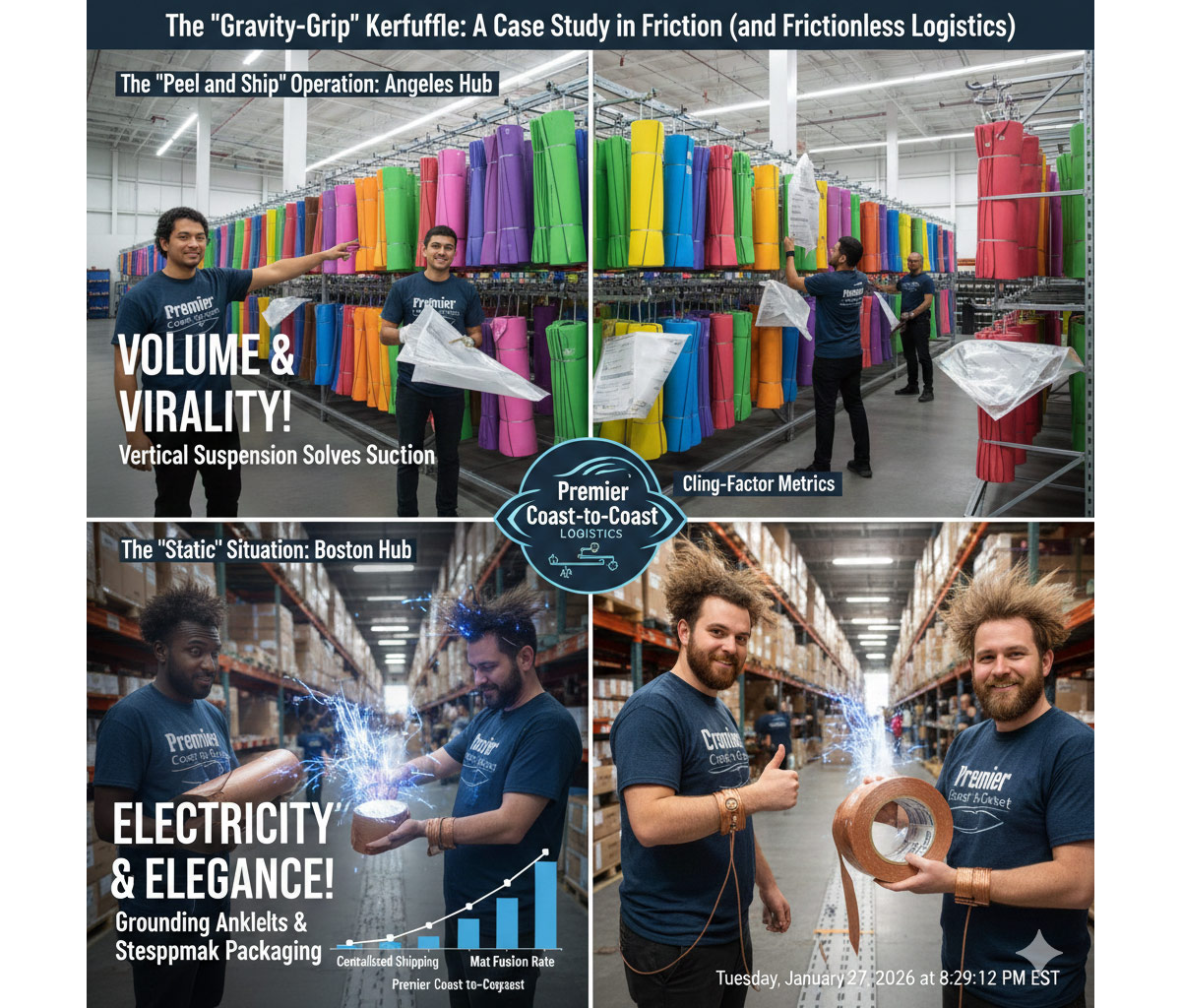
The Los Angeles Hub: The “Peel and Ship” Operation
In our L.A. facility, the challenge was volume. The West Coast launch went viral on a popular video-sharing app because a famous influencer got her leggings stuck to the mat and had to be cut out of them. Suddenly, everyone wanted one.
- The Problem: We received 10,000 units of individual mats that were protected only by a thin layer of “De-Ionized Paper.” If that paper ripped, the mat would bond to the warehouse racking.
- The Solution: Our L.A. team implemented the Vertical Suspension Method. Instead of stacking them, we used specialized hooks to hang the mats like cured meats in a deli.
The Result: We reduced “surface-bond incidents” to zero and maintained a lightning-fast pick-and-pack rate. Because our L.A. warehouse is only miles from the port, we were able to fulfill the “Influencer Wave” in under 24 hours.
-
The Boston Hub: The “Static” Situation
While L.A. was dealing with volume, Boston was dealing with electricity. The air in a New England warehouse in late autumn is dry. Dry air + Static-Foam = A literal lightning factory.
- The Problem: Every time a picker grabbed a Gravity-Grip mat, they generated enough static electricity to jump-start a dead car battery. Our team was getting zapped so hard their hair was standing up for three days straight.
- The Solution: Sully, our Boston floor manager, didn’t panic. He outfitted the entire fulfillment team with Grounding Anklets. We also swapped our standard plastic packing tape for a specialized copper-infused linen tape that neutralized the charge upon contact.
The Result: Not only did we stop the accidental electrocution of our staff, but the copper tape became a “premium packaging feature” that Boston customers loved. It looked “steampunk,” apparently. We fulfilled 8,000 units across the Tri-State area without a single singed eyebrow.
The Fictional Data: Friction vs. Flow
To illustrate how our bi-coastal approach saved this launch, let’s look at the “Cling-Factor” metrics.
| Metric | Centralized Shipping (Hypothetical) | Premier Coast to Coast (Actual) |
|---|---|---|
| Transit Time | 5-7 Days | 1-2 Days |
| Mat Fusion Rate | 12% (Pallets became blocks) | 0.01% (One mat stuck to a stapler) |
| Shipping Cost | $22.00 per unit (Heavy/Oversized) | $9.50 per unit (Local Zone delivery) |
| Worker Morale | "I'm stuck to the floor" | "I love these grounding anklets" |
Why Your Boring Product Deserves This Treatment
You might be shipping coffee beans, phone cases, or artisanal spatulas. Your products probably don’t generate 50,000 volts of electricity or fuse to the walls.
But the logistics principles remain the same:
- Zone Skipping Saves Margins: By stocking in L.A. and Boston, you aren’t paying the “Cross-Country Tax.” You’re paying local rates.
- Specialized Handling: Every product has a quirk. We don’t just “box it.” We understand it. If your product shouldn’t be stacked, we don’t stack it. If it shouldn’t be shaken, we cradle it.
- Scalability: When a product goes viral (for better or worse), you need two engines running, not one. If a blizzard hits Boston, your L.A. hub keeps the revenue flowing.
The Aftermath
The Gravity-Grip Infinite Yoga Mat is now a cult classic. Sub-Zero Gravity Labs is currently developing a “Frictionless Frying Pan” that is so slippery it’s actually illegal in three states.
Our L.A. and Boston teams are already preparing. We’ve ordered a shipment of high-friction gloves and a lot of industrial-strength nets.
Scaling Your Brand Shouldn’t Feel Like a Logistics Nightmare
You’ve done the hard part: you’ve built a brand people love. But as orders pour in, the “behind-the-scenes” can quickly become a bottleneck. If you’re spending more time taping boxes than chasing your next big idea, it’s time to level up.
Why Medallion Fulfillment & Logistics?
-
Bi-Coastal Efficiency: Slash shipping zones and delivery times with strategic warehouse locations that put your product closer to your customers.
-
Seamless Tech Integration: Whether you’re on Shopify, Amazon, or Magento, our system plugs directly into your store for real-time inventory and order tracking.
-
The “Unboxing” Experts: We specialize in custom kitting and high-touch packaging. We don’t just ship products; we deliver your brand’s personality.
-
Scalability on Demand: Whether you’re shipping 100 orders or 100,000, our infrastructure grows with you—no extra overhead required.
Ready to get back to what you do best? Let us handle the heavy lifting. Experience the precision, speed, and personal touch that have made Medallion a leader in eCommerce logistics.